In grammar we talk about irregular verbs (and sometimes nouns: child/children, e.g.). Steven Pinker points out that children learn the past tense of irregular verbs very early, before they learn the rules for forming past tenses. They know that the past tense of "go" is "went" in just the same way that they know that the past tense of "talk" is "talked." When they get a little older, though, they twig to the rule, and start applying it to irregular verbs: "I goed to the playground." They use irregular verbs correctly before we use them incorrectly, and then we have to relearn the irregularities.
Here's how I would describe the phenomenology of this piece of grammatical knowledge: we learn past tense (or aspect) and fully internalize it. "Went" is as fully the past tense of "go" as "talked" is of "talk." Or it would actually be better to reverse the order: "Talked" bears the same, completely transparent, relation to "talk" as "went" does to "go." First we learn transparency.
Then, scientists in the nursery, we develop the rules of this transparency. Not that we specify them for ourselves. The rules are transparent too. They too are natural, and unspecified (cf. Witggenstein on rule following and Hannah Ginsborg on "primitive normativity"). We go for what "sounds right." But then we misapply the natural and give up on an earlier natural, internalized, disposition to say "went." Two natural and transparent rules come into some conflict, and we go with the one that's more recent and has a wider application: that one too sounds right, at least for a while.
But our elders correct us. We relearn the irregular verbs, and return to a more archaic natural transparency in their use. How much this is a return, and how much a newly internalized rule, can probably not be quite determined, but I suspect that the irregular verbs hang on, like all very basic pieces of language (e.g. the near-universal preservation of the proto-Indo-European word for hand in Indo-European languages), because they occur so early in our own individual experiences of language. I think that we return with a sort of archaic relief to the familiar irregularities of our early childhood.
It doesn't matter very much whether that's true or not, but if it is, it may shed some light on what will follow in my next post - where I will propose adding a new term to the lexicon of rhyme.
This is the first of a series of short posts about rhyme's relation to meter.
Thursday, February 2, 2012


Tuesday, January 17, 2012
Characters and agents in fiction, a post provoked by thinking about Richard III's boasts
One thing that fiction makes possible, and that makes fiction interesting, is the way it can show how what feels, in real life, like a simple and unified interaction with others occurs on several channels at once. Fiction mutes some of those channels, and therefore focuses our emotional attention, our attentive emotion, on those that remain. And it focuses the theorist's attention (as here) on the differences between those channels that remain open and those that are muted.
For example: in a play we and several hundred other people in an audience can be in the presence of a character who is entirely alone. The channel of their presence to us is open; the channel of our presence to them is muted (although not entirely). At a movie we can hear everything that one lover whispers to another in the absolute privacy of some erotic sanctum. (Our presence to the characters is completely muted, though our presence to the actors only partly so.) The way these figures are present to us when we are not present to them is what I mean by the separation of one channel from another. Usually, in the real world, presence is a commutative relation. If I am present to you, you're present to me. (Even sleeping isn't a counterexample: If I'm asleep and you're awake, neither is present to the other.) But in fiction this apparently axiomatic double relation is no longer one (that is what makes it fiction).
This general idea allows us to see that first person narrative, at least since the nineteenth century, will frequently involve a narrator presenting herself to us in written words that she has never been supposed to have written. The written words are the way she's present to us; her never having written them is the way we're not present to her, since she never addresses us in her world. The channel in which her words exist is the channel we receive on, not the channel she receives on, even if she's writing.
It might be useful to establish a couple of preliminary distinctions in our vocabulary to help keep us clear on this issue. First, distinguish between a true first person narrator and a false one. What I am calling a false first person narrator is really just another character (focalized as much as you like) whose utterance a third person or omniscient narrator reports. Clarissa reports the letters that it collects, and all the first person narrative in those letters may be thought of as quoted discourse. (The true first person narrator of Clarissa, the narrator who addresses us or such as us, is the putative editor of this correspondence.) Poe quotes the full MS that Arthur Gordon Pym has written. But Ishmael addresses us directly in Moby Dick. We can then establish a pretty strong boundary (it's not absolute, but its breach, as in Proust, is always interesting) between what it may be useful to call true narrators and reported narrators.
Let's also distinguish between a character (in the sense of personality) and an agent. Usually this distinction will count most when applied to a true narrator. The narrator will do things in the work she narrates, will be an agent in that narrative (interacting with other agents, as, for example, when Nick brings Daisy and Gatsby together). Insofar as she does that, she's an agent as well as a character or personality.
All agents are characters but the two terms are not synonymous. We can separate off the idea of character by noting that part of out sense of her as a character (part of the fiction's presentation of her as a personality) is established or nuanced or complicated by what she says to us, even though she does not say these things in the world she lives in, wholly lives in, as an agent. The shocking moment that Nick talks of Gatsby's "appalling sentimentality" tells us much about Nick, but doesn't affect the plot of the book.
So a narrator's tone, judgment, voice, expectations, and so on, all affect our sense of the narrator as a character and so also affect our sense of the narrator as agent, even though these things do not belong to her as an agent within the fiction.
This leads to interesting and I believe somewhat unexpected insights. I've noted elsewhere how interesting it is that despite the fact that we can make the distinction between narrator and agent it's not quite absolute. It almost always seems to violate fair play to have a true narrator die (as in Susannah Moore's Whiteness of Bones [highlight if you don't mind the spoiler: not a great book, but still]). Ishmael must escape to tell us, even if he doesn't tell us as an agent. How else could be be narrating? It doesn't matter that we don't expect the narrator to have ever written the words we read, perhaps none of them. We still require that the voice which addresses us belongs to a character (NB: not to an agent) who is still alive, still exists, still can speak. Usually, in a written text, we require that it belong to a literate character, one who could write what we're reading. (Norman Rush's dialect works may provide a counterexample, but it's also possible that we process works narrated in a dialect we know not to be the author's as narrated by what I called a false first person narrator.) The Murder of Roger Ackroyd offers more to think about: the narrator just sounds too different from the agent designated by the same first-person pronouns for everyone to feel comfortable with the trick Christie plays. True first person narration occurs in some modal, subjunctive world.
Not, though, a possible world: the point is in no world does the frue first-person narrator actually write the narrative. We see no contradiction in such last sentences as: "She asked me to promise I would never tell anyone any of this [what we've just read], and that's a promise I'll always keep." But in no possible world could that sentence seem innocuous. It always and knowingly bridges two worlds (as Lewis says we mustn't).
Borges's "Secret Miracle" is relevant here, at least as an emblem of what I mean, or perhaps its reciprocal converse. The miracle is the work; the secret is its non-existence in the world in which it's written.
I'll note one minor but interesting effect of this muting of full commutative communication between fictional addressor and us real addressees: It makes a certain kind of boasting possible. Richard III and Iago, in their various soliloquies, rejoice in being able to act like the "formal vice, Iniquity," rejoice in their own cleverness, in being tricksters. Had they boasted as agents, in the worlds they inhabit, they would, by the laws of narrative (in our culture anyhow), inevitably fail. Boasters get shown up. Soft-spoken understaters surprise.
But the boasting they do is not boasting in their world. They boast to us, not to their compeers. And so they are setting forth the parameters of the challenges they will meet, doing it for us. The magician's relish they take in difficulty is something we need to know. It wouldn't work in their world, but it does in ours. The difficulty and boasting are present to us, but not a presence in the world they inhabit.
Since I think this situation, this non-commutative presence, is the key issue here, we can say that all these moments: narration, boasting, the privacy and unawareness of figures in fiction, are paradoxically enough, versions of the same thing. Richard's boasting and Isabel Archer's silent thinking are really different manifestations of one relation to us.
Note:
It's no wonder if this seems like our beliefs about our parents' attitude towards us. For in real life, that non-commutative relation to others is what the child believes about its parents. I am not fully present to them. They transcend me. Yes, they sometimes ignore more and sometimes boast to me and sometimes rebuke me and sometimes tell me about themselves. But in none of those cases am I interacting with them in the world they truly live in, as agents. All the evidence that they give me of being focused on me is worth as much or as little as the evidence that fictional agents give of being aware of me. Fiction is possible, in part, because it repeats a relation we have to those greatest of fantasy figures, the actors in the family romance of which we are in the end spectators (so we think). And fiction shows how the family romance can work, through the separation of those things that serious adults, living real lives among real people, forget don't always come together, not, anyhow, in the awe-struck, humble eyes of the child, all absorbed in the fantastic world it is not and cannot be part of.
For example: in a play we and several hundred other people in an audience can be in the presence of a character who is entirely alone. The channel of their presence to us is open; the channel of our presence to them is muted (although not entirely). At a movie we can hear everything that one lover whispers to another in the absolute privacy of some erotic sanctum. (Our presence to the characters is completely muted, though our presence to the actors only partly so.) The way these figures are present to us when we are not present to them is what I mean by the separation of one channel from another. Usually, in the real world, presence is a commutative relation. If I am present to you, you're present to me. (Even sleeping isn't a counterexample: If I'm asleep and you're awake, neither is present to the other.) But in fiction this apparently axiomatic double relation is no longer one (that is what makes it fiction).
This general idea allows us to see that first person narrative, at least since the nineteenth century, will frequently involve a narrator presenting herself to us in written words that she has never been supposed to have written. The written words are the way she's present to us; her never having written them is the way we're not present to her, since she never addresses us in her world. The channel in which her words exist is the channel we receive on, not the channel she receives on, even if she's writing.
It might be useful to establish a couple of preliminary distinctions in our vocabulary to help keep us clear on this issue. First, distinguish between a true first person narrator and a false one. What I am calling a false first person narrator is really just another character (focalized as much as you like) whose utterance a third person or omniscient narrator reports. Clarissa reports the letters that it collects, and all the first person narrative in those letters may be thought of as quoted discourse. (The true first person narrator of Clarissa, the narrator who addresses us or such as us, is the putative editor of this correspondence.) Poe quotes the full MS that Arthur Gordon Pym has written. But Ishmael addresses us directly in Moby Dick. We can then establish a pretty strong boundary (it's not absolute, but its breach, as in Proust, is always interesting) between what it may be useful to call true narrators and reported narrators.
Let's also distinguish between a character (in the sense of personality) and an agent. Usually this distinction will count most when applied to a true narrator. The narrator will do things in the work she narrates, will be an agent in that narrative (interacting with other agents, as, for example, when Nick brings Daisy and Gatsby together). Insofar as she does that, she's an agent as well as a character or personality.
All agents are characters but the two terms are not synonymous. We can separate off the idea of character by noting that part of out sense of her as a character (part of the fiction's presentation of her as a personality) is established or nuanced or complicated by what she says to us, even though she does not say these things in the world she lives in, wholly lives in, as an agent. The shocking moment that Nick talks of Gatsby's "appalling sentimentality" tells us much about Nick, but doesn't affect the plot of the book.
So a narrator's tone, judgment, voice, expectations, and so on, all affect our sense of the narrator as a character and so also affect our sense of the narrator as agent, even though these things do not belong to her as an agent within the fiction.
This leads to interesting and I believe somewhat unexpected insights. I've noted elsewhere how interesting it is that despite the fact that we can make the distinction between narrator and agent it's not quite absolute. It almost always seems to violate fair play to have a true narrator die (as in Susannah Moore's Whiteness of Bones [highlight if you don't mind the spoiler: not a great book, but still]). Ishmael must escape to tell us, even if he doesn't tell us as an agent. How else could be be narrating? It doesn't matter that we don't expect the narrator to have ever written the words we read, perhaps none of them. We still require that the voice which addresses us belongs to a character (NB: not to an agent) who is still alive, still exists, still can speak. Usually, in a written text, we require that it belong to a literate character, one who could write what we're reading. (Norman Rush's dialect works may provide a counterexample, but it's also possible that we process works narrated in a dialect we know not to be the author's as narrated by what I called a false first person narrator.) The Murder of Roger Ackroyd offers more to think about: the narrator just sounds too different from the agent designated by the same first-person pronouns for everyone to feel comfortable with the trick Christie plays. True first person narration occurs in some modal, subjunctive world.
Not, though, a possible world: the point is in no world does the frue first-person narrator actually write the narrative. We see no contradiction in such last sentences as: "She asked me to promise I would never tell anyone any of this [what we've just read], and that's a promise I'll always keep." But in no possible world could that sentence seem innocuous. It always and knowingly bridges two worlds (as Lewis says we mustn't).
Borges's "Secret Miracle" is relevant here, at least as an emblem of what I mean, or perhaps its reciprocal converse. The miracle is the work; the secret is its non-existence in the world in which it's written.
I'll note one minor but interesting effect of this muting of full commutative communication between fictional addressor and us real addressees: It makes a certain kind of boasting possible. Richard III and Iago, in their various soliloquies, rejoice in being able to act like the "formal vice, Iniquity," rejoice in their own cleverness, in being tricksters. Had they boasted as agents, in the worlds they inhabit, they would, by the laws of narrative (in our culture anyhow), inevitably fail. Boasters get shown up. Soft-spoken understaters surprise.
But the boasting they do is not boasting in their world. They boast to us, not to their compeers. And so they are setting forth the parameters of the challenges they will meet, doing it for us. The magician's relish they take in difficulty is something we need to know. It wouldn't work in their world, but it does in ours. The difficulty and boasting are present to us, but not a presence in the world they inhabit.
Since I think this situation, this non-commutative presence, is the key issue here, we can say that all these moments: narration, boasting, the privacy and unawareness of figures in fiction, are paradoxically enough, versions of the same thing. Richard's boasting and Isabel Archer's silent thinking are really different manifestations of one relation to us.
Note:
It's no wonder if this seems like our beliefs about our parents' attitude towards us. For in real life, that non-commutative relation to others is what the child believes about its parents. I am not fully present to them. They transcend me. Yes, they sometimes ignore more and sometimes boast to me and sometimes rebuke me and sometimes tell me about themselves. But in none of those cases am I interacting with them in the world they truly live in, as agents. All the evidence that they give me of being focused on me is worth as much or as little as the evidence that fictional agents give of being aware of me. Fiction is possible, in part, because it repeats a relation we have to those greatest of fantasy figures, the actors in the family romance of which we are in the end spectators (so we think). And fiction shows how the family romance can work, through the separation of those things that serious adults, living real lives among real people, forget don't always come together, not, anyhow, in the awe-struck, humble eyes of the child, all absorbed in the fantastic world it is not and cannot be part of.
Monday, December 12, 2011
Tasks and answers
(A short post to keep my hand in, while I write the two overdue things I'm writing and finish up the semester....)
One of the great and difficult things about King Lear is its fairy-tale quality. Writing gripping and unmotivated situations - nothing seems easier, but nothing is harder. Even the Mariner's shooting of the albatross doesn't quite do it, as Coleridge himself acknowledged when Anna Letitia Barbauld complained of the story's want of moral point:
He means the question to set him up as the judge of their answers - a finely fatherly thing to do. But the question is deeper than that, I've just been realizing: it's the question of the play. Which daughter will he say loves him most? And the answer comes only at the end, when he finally says that it's Cordelia. That question is answered for us, but for her also: "Which of you?" The second person matters: it's when he says it to her that the question is answered. We wait, and she waits, for the answer during the whole play. It is then that he gives the answer to the question he has unwillingly posed himself. He had no idea that the question was not simply the catalyst of what comes next but the question of the play. Will he say it? About Cordelia? When?
The "shall" turns out to indicate the whole temporal span of the play: Lear's fairy tale question and fairy tale crisis also shows him setting himself the task that it will take the whole play to fulfill: saying who loves him most. And when he does that, everything's over. But the second person also matters because he's setting her the task (in proper Proppian form): make him say it. And that takes the whole play and her whole life, and his whole life too.
I think this is all obvious, and yet I think somehow it's not: that the story is simpler and deeped than anything in Tolstoy, which is why he (Tolstoy) disparaged it. The best fairy-tale writer of the nineteenth century, Tolstoy's works have the fairy-tale slyness of the Chronicle History of King Leir. Perhaps they sometimes rival the the austere complexity, that is to say the simplicity, of King Lear. But it's King Lear that they rival.
One of the great and difficult things about King Lear is its fairy-tale quality. Writing gripping and unmotivated situations - nothing seems easier, but nothing is harder. Even the Mariner's shooting of the albatross doesn't quite do it, as Coleridge himself acknowledged when Anna Letitia Barbauld complained of the story's want of moral point:
Mrs Barbauld tole me that the only faults she found with the Ancient Mariner were — that it was improbable and had no moral. As for the probability — to be sure that might admit some question — but I told her that in my judgment the poem had moral, and that too openly obtruded on the reader, It ought to have no more moral than the story of the merchant sitting down to eat dates by the side of a well and throwing the shells aside, and the Genii starting up and saying he must kill the merchant, because a date shell had put out the eye of theIt's worth remembering that Barbauld was an innovative and charismatic teacher as well as poet, and that she wrote a good deal, and successfully for children. But Coleridge was after that near-impossible quality: gratuitous narrative that brings you in so quickly that you don't have time to wonder why or how such situations should ever arise. To see what I mean notice how well Kafka achieves something akin to the great beginning of the Grimms's "Town Musicans of Bremen" --
Genii's son.
A man had a donkey, who for long years had untiringly carried sacks to the mill, but whose strength was now failing, so that he was becoming less and less able to work. Then his master thought that he would no longer feed him, but the donkey noticed that it was not a good wind that was blowing and ran away, setting forth on the road to Bremen, where he thought he could become a town musician-- in the opening of the Metamorphosis:
As Gregor Samsa awoke one morning from troubled dreams he found himself transformed in his bed into a monstrous insect. He was lying on his hard, as it were armor-plated, back and when he lifted his head a little he could see his dome-like brown belly divided into corrugated segments on top of which the bed quilt could hardly keep in position and was about to slide off completely. His numerous legs, which were pitifully thin compared to the rest of his bulk, flimmered helplessly before his eyes. [Nabokov's modified translation of the Muirs with one reversion to their version; "flimmered" is his portmanteau of flickered and shimmered]Shakespeare achieves what Coleridge doesn't at the beginning of King Lear. His source -- the Chronicle History of King Leir -- has the King set the love contest up as a trick. He is sure that Cordella will vow her absolute love and obedience to him, which will then enable him to require her to marry the husband he has picked for her rather than the man she loves (cf. the less fairy-tale-like Midsummer Night's Dream). In Shakespeare's version, Lear simply asks the question:
Which of you shall we say doth love us most?
He means the question to set him up as the judge of their answers - a finely fatherly thing to do. But the question is deeper than that, I've just been realizing: it's the question of the play. Which daughter will he say loves him most? And the answer comes only at the end, when he finally says that it's Cordelia. That question is answered for us, but for her also: "Which of you?" The second person matters: it's when he says it to her that the question is answered. We wait, and she waits, for the answer during the whole play. It is then that he gives the answer to the question he has unwillingly posed himself. He had no idea that the question was not simply the catalyst of what comes next but the question of the play. Will he say it? About Cordelia? When?
The "shall" turns out to indicate the whole temporal span of the play: Lear's fairy tale question and fairy tale crisis also shows him setting himself the task that it will take the whole play to fulfill: saying who loves him most. And when he does that, everything's over. But the second person also matters because he's setting her the task (in proper Proppian form): make him say it. And that takes the whole play and her whole life, and his whole life too.
I think this is all obvious, and yet I think somehow it's not: that the story is simpler and deeped than anything in Tolstoy, which is why he (Tolstoy) disparaged it. The best fairy-tale writer of the nineteenth century, Tolstoy's works have the fairy-tale slyness of the Chronicle History of King Leir. Perhaps they sometimes rival the the austere complexity, that is to say the simplicity, of King Lear. But it's King Lear that they rival.
Saturday, November 12, 2011
More on the Clock
Went back to watch another hour of Christian Marclay's Clock today. Very wittily, at 4:45 p.m. Marclay has a clip in which a museum is being closed in that way that museums that close at 5 really start closing at 4:45 -- wittily because just then a stentorian guard came in to intone, over the movie (which kept playing) that it was 4:45 and the museum was about to close and we'd have to make our way towards the exits. Art museum life imitates art museum art! Like that Oskar Schlemmer painting of the Bauhaus stairway hung on the wall of the very similar stairway at the old MOMA:
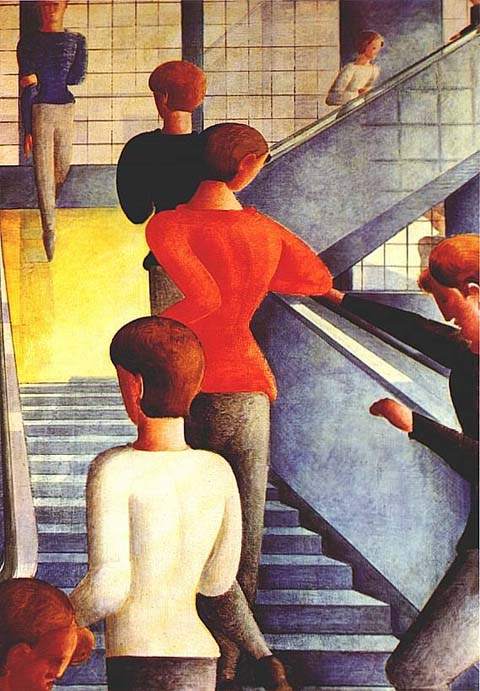
Anyhow, what I noticed this time: how well the cuts between scenes were made, so that there was a quasi-narrative going on (a person made a call at 4:12, a person picked it up a call in the next scene) - effect intensified by sound-bleeds from cut to cut (sometimes anticipating, sometimes lagging the cut).
Quasi-narrative is film's stock-in-trade. Film relies on the horizon of working memory, on coherence over the last minute or so, without much concern for what's over the horizon. (Memento is an exemplary demonstration of and inquiry into this idea.) Sure, most narrative films can be recollected later as more-or-less coherent narratives. But on the middle levels, the way scenes put people together or tear them apart, can only make sense if we forget that not one minute earlier everything was terrible, or everything was fine. And on the larger levels, many a movie is just as incoherent (cf. The Big Sleep): movies can afford to be. The Clock gives you a kind of mosaic of narrative, in working-memory-long clips.
This also made and makes cross-cutting work: as I said before, we recur to some narratives in which time is of the essence. We check back every time some character is also checking back. One of those today -- a chess game at a cafe with one of the players watching the tensely photographed clock, awaiting the murderer of the other, perhaps -- turned out to go on for at least half an hour in real time. No doubt in the original film, which I didn't know, the scene lasted more like three minutes, though also, it must be, with cross-cuts that we didn't get to see. (I think probably that there were no cross-cut clips in The Clock, that every cut to another location was Marclay's, not the source's.)
I also noticed the obvious but deep fact that every film in The Clock was fictional. This makes an interesting difference: it means that at no point can we infer what time it was in reality on the day the film was shot. (This is probably not strictly true: there must be location shots with real clocks in them. But still, the principle of the thing:) All the clocks and watches depicted fictional times. Sure, they might accidentally correspond to real times, just as there might accidentally and unknown to Doyle be a real Sherlock Holmes (David Lewis's example), who did and acted just as Doyle's fictional one did. But Doyle would not be referring to this one, and these clocks would not be referring to real time. But in our world they do, since The Clock is a clock, and you always know what time it is.
You know what time it is in the theater, though you may not know what time it is in the fiction. This is because in the sequence I saw today, some of the clocks were stopped. In a museum (perhaps the one that shooed people out at 4:45, but I don't think so), two characters look at a collage comprising pornographic magazine photos and photos of clocks, all showing the same time (the time The Clock is telling). Later a character comes in to find that his clock has been smashed. We can see when. It's the time on our watches. But clearly the clock has stopped long before. (And later there's another clip, Sound-and-the-Fury-ish, with a stopped watch and broken crystal, though I think maybe we see its owner breaking it with a hammer.) I wonder whether Marclay has the scene from Chinatown where J.J. picks up the crushed pocket watches he's placed under Mulwray's tires to see when he drove off. I wonder again - well, that's what the movie makes you do - whether Hitchcock winding the clock in Rear Window appears.
So what that made me realize is how much the movie is about clock- and watch-faces. How much, again, it's about movies themselves, and in particular watching movies, watching faces, looking at the photographed face. Hitchcock's joke in the Mt. Rushmore scenes of North By Northwest and Marclay's is about the fact that movies show faces on screen at unprecedented sizes: human and clock faces. (Well, Big Ben may be as big as any photographed clock, I guess.)
As Gloria Swanson put it in Sunset Boulevard: "We had faces!"
Anyhow, what I noticed this time: how well the cuts between scenes were made, so that there was a quasi-narrative going on (a person made a call at 4:12, a person picked it up a call in the next scene) - effect intensified by sound-bleeds from cut to cut (sometimes anticipating, sometimes lagging the cut).
Quasi-narrative is film's stock-in-trade. Film relies on the horizon of working memory, on coherence over the last minute or so, without much concern for what's over the horizon. (Memento is an exemplary demonstration of and inquiry into this idea.) Sure, most narrative films can be recollected later as more-or-less coherent narratives. But on the middle levels, the way scenes put people together or tear them apart, can only make sense if we forget that not one minute earlier everything was terrible, or everything was fine. And on the larger levels, many a movie is just as incoherent (cf. The Big Sleep): movies can afford to be. The Clock gives you a kind of mosaic of narrative, in working-memory-long clips.
This also made and makes cross-cutting work: as I said before, we recur to some narratives in which time is of the essence. We check back every time some character is also checking back. One of those today -- a chess game at a cafe with one of the players watching the tensely photographed clock, awaiting the murderer of the other, perhaps -- turned out to go on for at least half an hour in real time. No doubt in the original film, which I didn't know, the scene lasted more like three minutes, though also, it must be, with cross-cuts that we didn't get to see. (I think probably that there were no cross-cut clips in The Clock, that every cut to another location was Marclay's, not the source's.)
I also noticed the obvious but deep fact that every film in The Clock was fictional. This makes an interesting difference: it means that at no point can we infer what time it was in reality on the day the film was shot. (This is probably not strictly true: there must be location shots with real clocks in them. But still, the principle of the thing:) All the clocks and watches depicted fictional times. Sure, they might accidentally correspond to real times, just as there might accidentally and unknown to Doyle be a real Sherlock Holmes (David Lewis's example), who did and acted just as Doyle's fictional one did. But Doyle would not be referring to this one, and these clocks would not be referring to real time. But in our world they do, since The Clock is a clock, and you always know what time it is.
You know what time it is in the theater, though you may not know what time it is in the fiction. This is because in the sequence I saw today, some of the clocks were stopped. In a museum (perhaps the one that shooed people out at 4:45, but I don't think so), two characters look at a collage comprising pornographic magazine photos and photos of clocks, all showing the same time (the time The Clock is telling). Later a character comes in to find that his clock has been smashed. We can see when. It's the time on our watches. But clearly the clock has stopped long before. (And later there's another clip, Sound-and-the-Fury-ish, with a stopped watch and broken crystal, though I think maybe we see its owner breaking it with a hammer.) I wonder whether Marclay has the scene from Chinatown where J.J. picks up the crushed pocket watches he's placed under Mulwray's tires to see when he drove off. I wonder again - well, that's what the movie makes you do - whether Hitchcock winding the clock in Rear Window appears.
So what that made me realize is how much the movie is about clock- and watch-faces. How much, again, it's about movies themselves, and in particular watching movies, watching faces, looking at the photographed face. Hitchcock's joke in the Mt. Rushmore scenes of North By Northwest and Marclay's is about the fact that movies show faces on screen at unprecedented sizes: human and clock faces. (Well, Big Ben may be as big as any photographed clock, I guess.)
As Gloria Swanson put it in Sunset Boulevard: "We had faces!"
Saturday, November 5, 2011
Names of Works: Names ("Turn of the Screw," for example)
What does Reservoir Dogs mean? Everyone knows: it's that movie that established Quentin Tarantino's reputation for gripping pulp violence, for a kind of pop pleasure in the interactions of large, primary-colored characters (figuratively as well as by way of their names) punctuated by violence, but where the violence isn't quite our central anxiety but part of the stakes in the story. Before you go see the movie, you assume you'll find out the significance of its title in the movie; afterwards you do know the significance: it's the perfect title for that Quentin Tarentino movie.
Yet, if you've seen it you know that there's no reservoir, no dog, no reference to their concatenation in the movie. Somehow the completely gripping story so fills your mind that when you've watching it, you don't notice that it skips the part where the meaning of the title gets explained. By the end, it just means that Quentin Tarantino movie, Reservoir Dogs.
Tarantino does this so effectively that we can see something really wonderful: an idiom aborning. The title has the same linguistic effect as an idiom: a piece of language that means the way words mean, but not by virtue of the combination that it comprises. The whole phrase easily dissolves into the flow of meaning, just like any other word. The hotly contested philosophical distinction between names and definite descriptions (cf. Russell, Kripke) comes undone in the case of what we could call the idiomatic name, the name that starts out looking like a description and then, after a while, doesn't.
I was thinking about this because I was thinking about The Turn of The Screw, and what the title means. Everyone knows, right? that Henry James novel, and also the sense of twist after possible twist. But why "turn of the screw"? The phrase appears in the novel twice, in that strange way that James has of treating bits of language as though they're common coin, even though they're not ("hang fire" being perhaps the most notorious). In the frame narrative, Douglas remarks about the ghost story that Griffin has just told,
Anyhow, the phrase is not an idiomatic one before James made it one. It does have an origin though: it's the title of a chapter in Bleak House ("A Turn of the Screw") in which Phil calls Joshua Smallweed "a screw and a wice in his actions." Thus the turn of the screw is the gradual increase of pressure, tightening what is already tight, turning a structure into nothing but itself, the way an idiom comes to mean only that untranslatable thing that the idiom captures so well.
This is essentially Blanchot's reading of the story. His great insight (greater even than what he was the first to remark: that the story is studiously and relentlessly ambiguous, not only about the real existence of the ghosts, but about whether it's ambiguous at all, an ambiguity which requires Miles to die) - his great insight is the importance of the fact that the governess is the narrator. What this means, he says, is not only that we don't know whether she's reliable, but that the subject of the story is its own narration, the narration of the fact that the narration is at issue. It's her story, which means that the content of the narrative is that it is a narrative: as with Proust it is, in the end, the story of the narrator as narrator.
Blanchot doesn't want to make this into some standard circular paradox of self-referentiality, any more than Proust does. He wants to see this collapsing of the difference between narrative and thing narrated as the pressure of narrative itself, increased sufficiently to squeeze out of narrative everything inessential, everything that isn't, finally, narrative pressure, so that the pressure of narrative is finally what it is: a pressure to be found only in the irreality of fiction because no fact of the matter, no truth, can come to resolve and relieve that pressure. The turn of the screw tightens the fiction to itself, makes of the work its own idiom or idiolect, a language you can learn but not one that you can translate, not in any literal, vulgar way, as we are warned from the start:
Yet, if you've seen it you know that there's no reservoir, no dog, no reference to their concatenation in the movie. Somehow the completely gripping story so fills your mind that when you've watching it, you don't notice that it skips the part where the meaning of the title gets explained. By the end, it just means that Quentin Tarantino movie, Reservoir Dogs.
Tarantino does this so effectively that we can see something really wonderful: an idiom aborning. The title has the same linguistic effect as an idiom: a piece of language that means the way words mean, but not by virtue of the combination that it comprises. The whole phrase easily dissolves into the flow of meaning, just like any other word. The hotly contested philosophical distinction between names and definite descriptions (cf. Russell, Kripke) comes undone in the case of what we could call the idiomatic name, the name that starts out looking like a description and then, after a while, doesn't.
I was thinking about this because I was thinking about The Turn of The Screw, and what the title means. Everyone knows, right? that Henry James novel, and also the sense of twist after possible twist. But why "turn of the screw"? The phrase appears in the novel twice, in that strange way that James has of treating bits of language as though they're common coin, even though they're not ("hang fire" being perhaps the most notorious). In the frame narrative, Douglas remarks about the ghost story that Griffin has just told,
"I quite agree—in regard to Griffin's ghost, or whatever it was—that its appearing first to the little boy, at so tender an age, adds a particular touch. But it's not the first occurrence of its charming kind that I know to have involved a child. If the child gives the effect another turn of the screw, what do you say to two children—?"And then later (though earlier in time), towards the end, the Governess describes yet once more the line she's had to pursue throughout her time at Bly:
"We say, of course," somebody exclaimed, "that they give two turns! Also that we want to hear about them."
Here at present I felt afresh—for I had felt it again and again—how my equilibrium depended on the success of my rigid will, the will to shut my eyes as tight as possible to the truth that what I had to deal with was, revoltingly, against nature. I could only get on at all by taking "nature" into my confidence and my account, by treating my monstrous ordeal as a push in a direction unusual, of course, and unpleasant, but demanding, after all, for a fair front, only another turn of the screw of ordinary human virtue.Sure, Douglas could have picked up the phrase from her, but that seems to be considering it too curiously, as though we're suddenly supposed to think back to the way she's influenced Douglas at this moment when she's praising the ordinary, confronting the ordinary against the ordeal. It feels more as though the phrase itself has become virtuously, valorously, ordinary, idiomatic, something that people do, in that wonderful offhanded praise (so like James) of "ordinary human virtue." What is a turn of the screw of ordinary human virtue? Even with just this context, these contexts, it means something like a tightening up of the apparatus, to make it more "rigid" (her word), more capable of resisting the stress or push it undergoes.
Anyhow, the phrase is not an idiomatic one before James made it one. It does have an origin though: it's the title of a chapter in Bleak House ("A Turn of the Screw") in which Phil calls Joshua Smallweed "a screw and a wice in his actions." Thus the turn of the screw is the gradual increase of pressure, tightening what is already tight, turning a structure into nothing but itself, the way an idiom comes to mean only that untranslatable thing that the idiom captures so well.
This is essentially Blanchot's reading of the story. His great insight (greater even than what he was the first to remark: that the story is studiously and relentlessly ambiguous, not only about the real existence of the ghosts, but about whether it's ambiguous at all, an ambiguity which requires Miles to die) - his great insight is the importance of the fact that the governess is the narrator. What this means, he says, is not only that we don't know whether she's reliable, but that the subject of the story is its own narration, the narration of the fact that the narration is at issue. It's her story, which means that the content of the narrative is that it is a narrative: as with Proust it is, in the end, the story of the narrator as narrator.
Blanchot doesn't want to make this into some standard circular paradox of self-referentiality, any more than Proust does. He wants to see this collapsing of the difference between narrative and thing narrated as the pressure of narrative itself, increased sufficiently to squeeze out of narrative everything inessential, everything that isn't, finally, narrative pressure, so that the pressure of narrative is finally what it is: a pressure to be found only in the irreality of fiction because no fact of the matter, no truth, can come to resolve and relieve that pressure. The turn of the screw tightens the fiction to itself, makes of the work its own idiom or idiolect, a language you can learn but not one that you can translate, not in any literal, vulgar way, as we are warned from the start:
Mrs. Griffin, however, expressed the need for a little more light. "Who was it she was in love with?"Waggish's recent post on MacGuffins put me in mind of this. For Hitchcock (and others) the MacGuffin is the mechanical narrative rabbit (hence the rabbit's foot of MI 3, perhaps), that the greyhounds of plot baying after it. But for Blanchot (and, if ironically, for Blumenberg) the MacGuffin isn't just (to change the metaphor) a catalyst, some reagent that gets things going and then withdraws. It's the work itself, the fact of narrative or of fiction, the thing that fiction wants to be able to tell: the significance of its own existence. And that's what it can't tell in any literal, vulgar way: if it could, its existence wouldn't be significant. If you chase the MacGuffin in James, or in Proust, or in Kafka (Blanchot compares the three of them) you may indeed go over to the world of parable. Is this in reality possible? Of course not. Only in parable. You have to learn another language and make its idioms your own, even if they don't translate into anything in your native tongue.
"The story will tell," I took upon myself to reply.
"Oh, I can't wait for the story!"
"The story won't tell," said Douglas; "not in any literal, vulgar way."
Sunday, October 23, 2011
Lewis on Fictional Worlds
My friends assure me that D.K. Lewis was completely serious about his belief in the real existence of possible worlds. For me they're a useful heuristic, but I guess it helps to go whole hog, since to do that commits you to a more robust view of truth: it really is true in a possible world that something possible happened although it didn't happen here. Lewis's idea makes truth more robust by shifting the adjective possible from modifying truth to modifying a set of worlds. Then not only are possible things true in some worlds, but it is true, pure and simple, that in all worlds taken together every possible thing is true.
Which can be a depressing idea, depending on the vividness of your imagination, and depending also on your views of counterparts and zombies and the like. (I myself would want instead to assume that all my counterparts are zombies, and that I escape death at every moment by threading the maze of worlds where my counterparts, are, at every moment, dying. I could believe in a kind of asymptotic immortality this way, or a kind of perpetual standing wave of reincarnation into some still-living version of myself. Or, really, a kind of packet-switching of the entity or identity consisting of myself plus all my zombie counterparts; me, I'd always exist in one of the packets getting through to the future, and not in the packets that weren't. This suggests, by the way, a reason to be a one-boxer: I want to live in one of the one-box worlds. Lewis, a two-boxer, himself admits that the one-boxers would do better than he would, as a matter of fact. He'd still pick one box though, since that couldn't causally change his outcome. But to resume the thread of my discourse....)
If Lewis is serious, and if he's right, he would justify, and also give a spooky and discomfiting authority to, a kind of literary fiction (and fan fiction too) which it's harder to justify if there's just one world, "la vie, la seule qu'on a." Here's how Lewis says we should think about fictional worlds:
So every consistent and possible fictional world really exists, somewhere. Then the work of the writer of "realistic" fiction (where realistic means something like "possible") is a kind of discovery of truth, the truths consistent with the writer's possible and therefore true premises. It's like math, or like chess, or like their intersection: given a possible state of affairs, here is an array of incidents, events, characters, interactions, and outcomes consistent with it. Since possible states of affairs are all of them true somewhere, so are all the incidents, event, characters, interactions, and outcomes consistent with them. The fiction writer discovers truths which we might be glad to know, or be horrified to know. But they are true, somewhere (unless you go my zombie route, in which case their truth won't matter as much: they'll just really be avatars -- in the gaming sense, not the strongly counterpartial sense in which they'd have something of the meaning they have as reincarnations - coincarnations, perhaps, of real souls.)
So reading fiction is reading about something that's true somewhere. If there are inconsistencies, then your reading about multiple truths, all of which may obtain in different places, even if not simultaneously. And the kind of literary criticism so popular a century or so ago, where critics hazard and argue for strange back-stories: all that's true too. Hamlet was a woman (in many many worlds, in all the worlds in which she existed); was Claudius's son; was his daughter; was old Hamlet's murderer. Desdemona did betray Othello with Cassio (in many, many worlds), and Emilia did sleep with Othello in many of them. Fan fiction consistent with the authoritative fiction it riffs on is all true too, somewhere.
Yes, all consistent fan fiction is true, and all consistent back-story mongering is true, but I am making a stronger claim than that. It can be, is somewhere, true of our Hamlet, our Desdemona, that is to say, Shakespeare's Hamlet and Desdemona, if it is (possibly) consistent with what we know about them. But if it is consistent with what we know about them, well then these are things that are true, and true in possible worlds as close as you could want them to be to our own. ("Closeness" of possible worlds is how Lewis handles overall resemblance or divergence between worlds. The worlds in which Hamlet has three eyes and is green are farther from us than the worlds in which he looks like Jude Law.)
Maybe literary critical arguments are another way of arguing for or against closeness of possible worlds. "Only an idiot would think Claudius was innocent" really means "The possible worlds in which Claudius is innocent are each much farther away than its almost perfect replica where he's guilty." Maybe. But that world still exists, and that story, that solution to the chess problem the play presents to its critics, is still true.
If Lewis is right, just imagine the Sartrean seriousness of the responsibility of the critic, or the fan-fictionist, or any audience member guessing at what happens after the story ends. It's not that we cause those worlds to exist by imagining them. It's that we come to know that they exist, and whatever claim those events have on our emotions is a claim we now can't dodge.
Writing would be like writing on an Etch-a-Sketch or frosted window: we expose fragments of what's behind it in our writing, and then can't unlearn what we've learned. As pure epistemological beings, we can know in theory that all possible things are true. But as empirical humans, the true things that we learn explicitly about have a very great claim on our attention and care, our Sorge. Which suggests we should be cautions about the truths we learn through exposing ourselves to fiction, or through exercising our own imaginations.
Luckily I can't believe any of these possible worlds are real, as the possibly still living and thus-believing Lewises do (or as our this-worldly Lewis was said to). But it's possible that they are. And then all you could do is hide.
(The whole thing is Lemian or Borgesian. Lewis would be committed to think, I am sure happily, that the whole Library of Babel really existed, extensionally. For Quine, the whole library may be found condensed, amply, in the alphabet.)
Which can be a depressing idea, depending on the vividness of your imagination, and depending also on your views of counterparts and zombies and the like. (I myself would want instead to assume that all my counterparts are zombies, and that I escape death at every moment by threading the maze of worlds where my counterparts, are, at every moment, dying. I could believe in a kind of asymptotic immortality this way, or a kind of perpetual standing wave of reincarnation into some still-living version of myself. Or, really, a kind of packet-switching of the entity or identity consisting of myself plus all my zombie counterparts; me, I'd always exist in one of the packets getting through to the future, and not in the packets that weren't. This suggests, by the way, a reason to be a one-boxer: I want to live in one of the one-box worlds. Lewis, a two-boxer, himself admits that the one-boxers would do better than he would, as a matter of fact. He'd still pick one box though, since that couldn't causally change his outcome. But to resume the thread of my discourse....)
If Lewis is serious, and if he's right, he would justify, and also give a spooky and discomfiting authority to, a kind of literary fiction (and fan fiction too) which it's harder to justify if there's just one world, "la vie, la seule qu'on a." Here's how Lewis says we should think about fictional worlds:
The worlds we should consider, I suggest, are the worlds where the fiction is told, but as known fact rather than fiction. The act of story-telling occurs, just as it does here at our world; but there it is what here it falsely purports to be: truth-telling about matters whereof the teller has knowledge.Lewis doesn't say why the fiction has to be told, perhaps because he thinks it's obvious: the world of the fiction is one in which the events occur and in which the fictional narrative also exists, since it is, at least implicitly, part of the fictional narrative that it exists. Now, I myself don't think that it is an implicit part of a narrative that it exists in the world it purports to describe, for reasons I've mentioned in previous posts, but I don't think this actually matters very much for Lewis's view. I'll note though that he does seem to worry a similar issue at the very end of the essay, when he raises a question about how to treat a fictional character who in the fiction is telling a fiction. But I think all we need to accept is that any consistent fictional world, as long as it is possible, really exists somewhere. Some of those worlds will indeed include true accounts of the events in the world that are counterparts of the fictional accounts of those events in our world. But I don't see that they need to. (In fact if they did need to, it would seem that there might be an infinite regress to worry about, since we'd have to add to any narrative that it is a true account of the world, which would change it and require another such assertion, etc. Lewis seems to prefer to go the way of collapsing iterations rather than allowing for this infinite regress, but sees the collapse as problematic too, since now it would be hard to keep separate fiction and the things that are fictional within that fiction.)
So every consistent and possible fictional world really exists, somewhere. Then the work of the writer of "realistic" fiction (where realistic means something like "possible") is a kind of discovery of truth, the truths consistent with the writer's possible and therefore true premises. It's like math, or like chess, or like their intersection: given a possible state of affairs, here is an array of incidents, events, characters, interactions, and outcomes consistent with it. Since possible states of affairs are all of them true somewhere, so are all the incidents, event, characters, interactions, and outcomes consistent with them. The fiction writer discovers truths which we might be glad to know, or be horrified to know. But they are true, somewhere (unless you go my zombie route, in which case their truth won't matter as much: they'll just really be avatars -- in the gaming sense, not the strongly counterpartial sense in which they'd have something of the meaning they have as reincarnations - coincarnations, perhaps, of real souls.)
So reading fiction is reading about something that's true somewhere. If there are inconsistencies, then your reading about multiple truths, all of which may obtain in different places, even if not simultaneously. And the kind of literary criticism so popular a century or so ago, where critics hazard and argue for strange back-stories: all that's true too. Hamlet was a woman (in many many worlds, in all the worlds in which she existed); was Claudius's son; was his daughter; was old Hamlet's murderer. Desdemona did betray Othello with Cassio (in many, many worlds), and Emilia did sleep with Othello in many of them. Fan fiction consistent with the authoritative fiction it riffs on is all true too, somewhere.
Yes, all consistent fan fiction is true, and all consistent back-story mongering is true, but I am making a stronger claim than that. It can be, is somewhere, true of our Hamlet, our Desdemona, that is to say, Shakespeare's Hamlet and Desdemona, if it is (possibly) consistent with what we know about them. But if it is consistent with what we know about them, well then these are things that are true, and true in possible worlds as close as you could want them to be to our own. ("Closeness" of possible worlds is how Lewis handles overall resemblance or divergence between worlds. The worlds in which Hamlet has three eyes and is green are farther from us than the worlds in which he looks like Jude Law.)
Maybe literary critical arguments are another way of arguing for or against closeness of possible worlds. "Only an idiot would think Claudius was innocent" really means "The possible worlds in which Claudius is innocent are each much farther away than its almost perfect replica where he's guilty." Maybe. But that world still exists, and that story, that solution to the chess problem the play presents to its critics, is still true.
If Lewis is right, just imagine the Sartrean seriousness of the responsibility of the critic, or the fan-fictionist, or any audience member guessing at what happens after the story ends. It's not that we cause those worlds to exist by imagining them. It's that we come to know that they exist, and whatever claim those events have on our emotions is a claim we now can't dodge.
Writing would be like writing on an Etch-a-Sketch or frosted window: we expose fragments of what's behind it in our writing, and then can't unlearn what we've learned. As pure epistemological beings, we can know in theory that all possible things are true. But as empirical humans, the true things that we learn explicitly about have a very great claim on our attention and care, our Sorge. Which suggests we should be cautions about the truths we learn through exposing ourselves to fiction, or through exercising our own imaginations.
Luckily I can't believe any of these possible worlds are real, as the possibly still living and thus-believing Lewises do (or as our this-worldly Lewis was said to). But it's possible that they are. And then all you could do is hide.
(The whole thing is Lemian or Borgesian. Lewis would be committed to think, I am sure happily, that the whole Library of Babel really existed, extensionally. For Quine, the whole library may be found condensed, amply, in the alphabet.)
Wednesday, October 19, 2011
Clock-watching, or Truth, sixty times an hour
In the Critique of Pure Reason, Kant offers some "axioms about time in general":
At any rate, I thought about some of this when I spent a couple of hours at Christian Marclay's The Clock, the real-time exhibition to end all real-time exhibitions.

As everyone knows, Marclay spliced together bits of film totaling twenty-four hours, each bit containing somewhere a (legible) clock, whether a digital sign like the one above, a wrist-watch, a sun-dial (I'm guessing: I don't think I saw one), or someone telling someone else the time. Some movies, parts of some scenes, appeared more than once -- if a character worried about the time keeps looking at his watch in some movie, his watch may appear more than once in that movie, as time hurries by or seems to drag on forever. Since most movies aren't in real time even when they're showing continuous time, the time difference between those clips is different (and more accurate) in The Clock from what it was in the original.

In His Girl Friday about twenty minutes passes on the clock in the twelve real minutes that Hildy and Walter are talking; in 24 the commercials allow for elisions but also compress the time a little bit so that particular deadlines can be met during the show and not during the ads. As far as I know High Noon is in genuine real time, as is Robert Wise's great boxing movie "The Set-Up" (1949).

You can certainly set your watch by The Clock, and one of the interesting parts of the experience is knowing what time it is as you watch; you don't have to worry about checking. Watching is checking. And yet you kind of forget that also: the fragments are all so gripping that you're hooked -- 60 times an hour. We regret leaving every scene for the next, or would regret it if the next scene weren't so immediately compelling. The movies!
 Part of being gripped, though, is looking for the watch or clock or time-piece in each scene. (It's a pleasure to see clocks you recognize from the real world. My watch was there! (Someone trying to pawn it for drugs, at just about 1:17 p.m. Kind of early in the day, come to think of it; must have been a heroin addict.) My grandmother's clunky alarm clock! So we watch (!) somewhat differently from the way we would the original movie. It might therefore seem surprising that we're hooked, scene after scene.
And yet in another way it's not surprising. The experience is decontextualized, in the best possible sense, the way movie trailers decontextualize the scenes they show. We get little fragments of intensity, all the more intense for being unexplained, unassimilated to some reasonable desire or goal or way of making oneself secure in the world, the goal of all characters in sequential narration.
Sequence again, then. The Clock quilts together scenes from a century or so of movies. We're not looking at the sequential unfolding of time. We're looking at different spaces, maybe 2,880 of them (the clips are not the same length; they probably average thirty seconds apiece, but who knows?) that are not simultaneous, and different times that are not sequential, but all brought to the spatial simultaneity, the spacial equivalent of simultaneity, on the video screen. Time and space are made mosaics of each other. We recognizes bits and pieces -- here a scene, there some sort of time-keeper. They all come together. It's beautiful.
Time has only one dimension; different times are not simultaneous but sequential (just as different spaces are not sequential but simultaneous).... Different times are only parts of one and the same time.... the proposition that different times cannot be simultaneous could not be derived from a universal concept.... Hence it is contained directly in the intuition and presentation of time. --Pluhar's translation, A32 = B48Sequence is how time is related to counting, which is to say that time can be measured by a numbering clock always counting upwards. Einstein's thought experiments about time really consist of showing the kinds of things that can act as clocks: viz., any physical system that follows the then recently articulated fundamental axioms of arithmetic: the idea of a defined interval and the idea of a succession of such intervals. (Thus two mirrors bouncing light back and forth to each other are a clock.) Since pretty much all things can be clocks (movies pre-eminently, ticking at 24fps), the universe of things is a universe subject to time. (The fact that Einstein proved Kant wrong is not really germane here: what matters is the domain that space and time map out.)
At any rate, I thought about some of this when I spent a couple of hours at Christian Marclay's The Clock, the real-time exhibition to end all real-time exhibitions.
As everyone knows, Marclay spliced together bits of film totaling twenty-four hours, each bit containing somewhere a (legible) clock, whether a digital sign like the one above, a wrist-watch, a sun-dial (I'm guessing: I don't think I saw one), or someone telling someone else the time. Some movies, parts of some scenes, appeared more than once -- if a character worried about the time keeps looking at his watch in some movie, his watch may appear more than once in that movie, as time hurries by or seems to drag on forever. Since most movies aren't in real time even when they're showing continuous time, the time difference between those clips is different (and more accurate) in The Clock from what it was in the original.
In His Girl Friday about twenty minutes passes on the clock in the twelve real minutes that Hildy and Walter are talking; in 24 the commercials allow for elisions but also compress the time a little bit so that particular deadlines can be met during the show and not during the ads. As far as I know High Noon is in genuine real time, as is Robert Wise's great boxing movie "The Set-Up" (1949).
This is from The Set-Up, at the end, and,
for all I know, from The Clock
You can certainly set your watch by The Clock, and one of the interesting parts of the experience is knowing what time it is as you watch; you don't have to worry about checking. Watching is checking. And yet you kind of forget that also: the fragments are all so gripping that you're hooked -- 60 times an hour. We regret leaving every scene for the next, or would regret it if the next scene weren't so immediately compelling. The movies!
And yet in another way it's not surprising. The experience is decontextualized, in the best possible sense, the way movie trailers decontextualize the scenes they show. We get little fragments of intensity, all the more intense for being unexplained, unassimilated to some reasonable desire or goal or way of making oneself secure in the world, the goal of all characters in sequential narration.
Sequence again, then. The Clock quilts together scenes from a century or so of movies. We're not looking at the sequential unfolding of time. We're looking at different spaces, maybe 2,880 of them (the clips are not the same length; they probably average thirty seconds apiece, but who knows?) that are not simultaneous, and different times that are not sequential, but all brought to the spatial simultaneity, the spacial equivalent of simultaneity, on the video screen. Time and space are made mosaics of each other. We recognizes bits and pieces -- here a scene, there some sort of time-keeper. They all come together. It's beautiful.
Subscribe to:
Posts (Atom)