A worm fed on the heart of Corinth,
Babylon and Rome.
Not Paris raped tall Helen,
But this incestuous worm,
Who lured her vivid beauty
To his amorphous sleep.
England! famous as Helen
Is thy betrothal sung.
To him the shadowless,
More amorous than Solomon.
It wasn't Paris because it was sexuality, the pleasure principle which Freud, just a couple of years later, and in the context of trying to understand "shell-shock" (PTSD), was applying to what he called the death drive.
The death drive is governered by the pleasure principle, though at first it seems that it can't be. But the desire for death is a desire for sleep or for rest. As Despayre counsels in The Faerie Queene "Death is the end of woes: die soone, O faeries sonne." It was the incestuous worm who raped tall Helen -- tall because the taller she is the greater her vertical descent to the horizongal grave (Rosenberg must be thinking of Hamlet's meditation on worms in the gravedigger scene). Raped as in carried her away (as Paris did who "lured" her); raped as in forced phallic, worm-like horror onto her.
The singularity of the worm from the first line -- "A worm" -- now gets further emphasis: "this incestuous worm." Why incestuous? Amazing word, and I think it means, again recollecting Hamlet, that the worm is equally related to all living things, that its rape of Helen and of Corinth and of Babylon and of Rome establish the absolute connection among them all, all paired with the worm.
He connects them all, so that he is the embodiment of their connection, which means that his grotesque bodily intimacy with them all is the incestuous intimacy between beings so closely related by their all being equally embodied by the worm.
We went to see the National Theatre's Vanya yesterday (HD broadcast at the movie theater) -- a one person show with Andrew Scott playing every role.
Do you need to know the Chekhov? I don't know. But Scott is just amazing. The Times and Guardian missed the point (though they acknowledged that his performance was a tour-de-force. But what he did was essentially to land halfway between Chekhov and Beckett. "Thus play I in one person many people," says Richard II, and that's what he does. It brings home the loneliness of the world, just as Beckett will later. And it got me thinking about Beckett's dramatic career, how we go from several people alone (Godot, Endgame) to one person mostly alone and covering for her loneliness through an unending stream of cheerful and optimistic conversational gambits (Happy Days) to a person entirely alone, but talking to his past self (Krapp to the void-filling desperation of complete solitude in which the speaker is trying to create a simulation Not I. I hadn't quite thought of it as that kind of progression before, but now I see it. And Scott's Vanya belongs to that progression somewhere, both before and after it. He makes you see what Beckett is doing, and makes you see how Beckette makes you see what Chekhov is doing.
I think Shakespeare, in the early seventeenth century, was thinking (or noticing) acts of self-interruption, and what they could do. When a speaker interrupts themselves, we realize that they're hearing just what we're hearing. So Hamlet interrupts his performance of Aeneas's tale to Dido:
The rugged Pyrrhus, like th’ Hyrcanian beast—
’tis not so; it begins with Pyrrhus:
The rugged Pyrrhus, he whose sable arms,
Black as his purpose, did the night resemble
When he lay couchèd in th’ ominous horse,
Hath now this dread and black complexion smeared
With heraldry more dismal. Head to foot,
Now is he total gules, horridly tricked
With blood of fathers, mothers, daughters, sons,
Baked and impasted with the parching streets,
That lend a tyrannous and a damnèd light
To their lord’s murder. Roasted in wrath and fire,
And thus o’ersizèd with coagulate gore,
With eyes like carbuncles, the hellish Pyrrhus
Old grandsire Priam seeks.
The interruption comes to a speech which considers others, those in an extreme condition, those the speaker -- Aeneas or Hamlet -- ie forever separated from, and yet who represent a universe one might live in, if one could.
Not long ago I commented on this speech in Macbeth:
Seyton!--I am sick at heart,
When I behold--Seyton, I say!--This push
Will cheer me ever, or disseat me now.
I have lived long enough: my way of life
Is fall'n into the sear, the yellow leaf;
And that which should accompany old age,
As honour, love, obedience, troops of friends,
I must not look to have; but, in their stead,
Curses, not loud but deep, mouth-honour, breath,
Which the poor heart would fain deny, and dare not. Seyton!
I was haunted by the way Macbeth has a set piece in mind, but is also alert to the world around him, to the fact of another person, even as he is aware of the encroaching limits of the world: the bourn that life sets on how far to be beloved, the bourn that no traveler returns from once they've crossed it. Somehow, despite a note comparing (and contrasting) Seyton as the last residual figure still loyal to the Macbeth to Lear's Fool, I don't think I'd ever put it together with a very similar moment in King Lear which I also love, and which may have been the play Shakespeare wrote right before Macbeth:
Prithee, go in thyself. Seek thine own ease.
This tempest will not give me leave to ponder
On things would hurt me more. But I’ll go in.—
In, boy; go first.—You houseless poverty—
Nay, get thee in. I’ll pray, and then I’ll sleep.
Poor naked wretches, wheresoe’er you are,
That bide the pelting of this pitiless storm,
How shall your houseless heads and unfed sides,
Your looped and windowed raggedness defend you
From seasons such as these?
Each interrupts himself and begins again after a kind of anacoluthon. They make a sort of gesture outwards to another, and then return to themselves, but after populating the emptiness around them with the possibilities of others: "troops of friends" or "you houseless poverty," "poor naked wretches, whereso'er you are." There's a fundamental loneliness that this evocation of others makes us feel: the loneliness of the others and not only of the soliloquist, a kind of sense, then of the fundamentality of loneliness.
For a long time, I've thought of Othello as a rewriting of Hamlet; it's possibly the next play Shakespeare wrote, and has the same relation to Hamlet as Macbeth does to Antony and Cleopatra, the same symphony of echoes. How then could I have missed till now that the willow song has to be about the death of Ophelia?
She was in love, and he she loved proved mad And did forsake her: she had a song of 'willow;'
An old thing 'twas, but it express'd her fortune,
And she died singing it: that song to-night
Will not go from my mind.
***
There is a willow grows aslant a brook,
That shows his hoar leaves in the glassy stream;
There with fantastic garlands did she come
Of crow-flowers, nettles, daisies, and long purples
That liberal shepherds give a grosser name,
But our cold maids do dead men's fingers call them:
There, on the pendent boughs her coronet weeds
Clambering to hang, an envious sliver broke;
When down her weedy trophies and herself
Fell in the weeping brook. Her clothes spread wide;
And, mermaid-like, awhile they bore her up:
Which time she chanted snatches of old tunes;
As one incapable of her own distress,
Or like a creature native and indued
Unto that element: but long it could not be
Till that her garments, heavy with their drink,
Pull'd the poor wretch from her melodious lay
To muddy death.
And the song itself makes its chorus its own "fantastic garland": "Sing all a green willow must be my garland."
Thursday, August 31, 2017
David Lewis, uses fictional worlds as a way of exploring the idea of the proximity of possible worlds, but confesses he's not quite sure what to do with fictions within fictions. One thing some writers have done is to write the actual (our-word) fictional work that some fictional work only mentions. They give it to us for our use. (This is the converse of the sort of thing that Borges and Lem do.)
A few such useful texts spring to mind right away, in chronological order:
Prencipe Galeotto: Dante has Francesca say of the book she and Paolo are reading together when they stop reading, "Galeotto fu 'l libro e chi lo scrisse." So Galeotto -- Prince Galahad (perhaps; it's not clear whether Dante identified Galeotto and Galahad), vicariously catalyzing their mutual seduction -- is both the author and the book itself. Boccaccio gives the Decameron the sub- or alternative title Prencipe Galeotto, making it into the book that Paolo and Francesca were reading, and promising it as a conversation piece for later lovers to seduce each other with.
Spenser completes one of Chaucer's Canterbury Tales, the Squire's, in Book IV of The Faerie Queene. (Spenser takes it as complete -- a real thing that Chaucer mentions, but that we don't have.
"Where is the Life that Late I Led?" Petruchio interrupts himself after he starts singing this song in Taming of the Shrew. Cole Porter gives us the whole song (with a bridge and a slight modification of Petruchio's second line).
"Childe Roland to the Dark Tower Came": Browning writes the poem that Edgar quotes in King Lear.
The Transfiguration of the Commonplace: From Muriel Spark's Prime of Miss Jean Brodie, the book that Sandy Stranger writes when she becomes a nun (Sister Helena). Arthur Danto (not Dante!) then wrote a book about the philosophy of art with that title.
The Secret Goldfish: D.B.'s "terrific book of short stories" in Catcher in the Rye, and the title of a book of short stories by David Means.
You know how there are talismanic quotations that you know, sufficiently so that you don't quite think them through? I think that's partly a result of rhythm: strict endings complete a line (that's a rule of Indo-European metrics); and rhythms structure and sometimes anchor the remembered words.
I've always loved these lines of Stevens's, from "The Plain Sense of Things":
Yet the absence of the imagination had
Itself to be imagined. The great pond,
The plain sense of it, without reflections, leaves,
Mud, water like dirty glass, expressing silence
Of a sort, silence of a rat come out to see,
The great pond and its waste of the lilies, all this
Had to be imagined as an inevitable knowledge,
Required, as a necessity requires.
Some time long ago I abbreviated them, without knowing it, as "The absence of the imagination had itself to be imagined, / Required, as a necessity requires." And it was only the first of those two pseudo-lines whose meaning I thought much about. The imagination would never be absent! To think so was to rejoin it, to imagine even that. "Disillusion as the last illusion," as Stevens says in a later poem. Or Beckett's: "Imagination dead, imagine!" (my punctuation).
The end of the poem, the end of my abbreviated version, was only what filled out the stirring, saving, Berkeleyan self-contradiction of trying to imagine the imagination absent.
But now I begin to wonder why the absence of the imagination was "required"? Why makes its absence, or imagining its absence, necessary?
I think if I thought about it at all that I took "required" to mean just a way of repeating had in "had to be imagined." It is required that you do euthanize your faith. But that's because I didn't really pay attention to the as of the last line. As a necessity required. We need to imagine necessity too. Ananke is not the iron law we cannot escape. It is the law we imagine we suffer under, but we need to imagine it. The rat can come out to see, whenever it wants to: it's a placidly, self-contained Rilkean animal, a denizen of the immediate.
But we need necessity, and the only question is whether our need for it is enough to count as need -- as we need it to be.
We know that the Elizabethan stage used doubling a lot: one actor, several characters. That saved money and made possible plays with a large set of characters. But it also allowed (like The Wizard of Oz) for a kind of metatheatrical linking of characters, and we know that Shakespeare loved metatheatrical moments: "too long for a play"; "my father died within these two hours"; or the moment when Jaques notices that a prose line (in a scene that's all prose) is also iambic pentameter, as many, perhaps the plurality of our fully formed sentences are:
ORLANDO: Good day and happiness, dear Rosalind!
JAQUES: Nay, then, God be wi' you, an you talk in blank verse.
Thus doubling can link Hamlet Senior to Claudius, if they're played by the same actor, or again the Fool to Cordelia (since they both very likely were played by Robert Armin), or Mamillius to Perdita.
So I was wondering about near-identical twins in Shakespeare -- he liked such Plautian stories as we know from The Comedy of Errors. But what about writing plays so that one actor can play both twins? Well if the twins are going to meet (and they are), you need two actors. But do you need them all the way through? I was thinking about this in Twelfth Night, and noticed this. Viola (dressed as the boy Cesario) exits Act I, Scene v after expostulating with Olivia. But the scene isn't over: Olivia broods about loving "him," then summons Malvolio to send him the ring, etc.
Next scene (II.i): enter Sebastian and Antonio. If the same actor is now playing Sebastian, the business at the end of the previous scene has given him time to change. They talk, express their love and mutual admiration, etc., and then off goes Sebastian. But Antonio stays on stage to say some more about how much he likes Sebastian and also why he (Antonio) has to be discrete. This gives the actor enough time to change again and begin the next scene (II.ii) as Viola/Cesario.
We next see Sebastian in III.iii, in a scene considerably later than Viola's last appearance in scene i; then after Sebastian's exit at the end of scene iii, Viola reappears in the next scene, but only half-way through it (again, plenty of time for the actor to change). She exits near the end of the scene, but some business after her exit between Sir Toby, Fabian, and Sir Andrew allows the actor time to change costume and re-enter as Sebastian in IV.i, where he first meets Olivia. Neither of them is in the next scene, so Sebastian doesn't have to change before he re-enters in IV.iii.
But he stays till the end of IV.iii, so Shakespeare has to write a little interchange for the beginning of the next scene (V.i) between Fabian and Feste before the actor re-enters as Viola/Cesario a few lines later. Into this last scene, of course, Sebastian will also enter, and he and Viola will reunite. But I suggest that it's only in this scene that a new actor plays Sebastian, so that he can appear on stage at the same time as Viola. (If you did a play version of The Prestige or of Dead Ringers it would be the same deal, I think.)
So I am now going to Google to see if this is generally known -- but I think it's a pretty cool thing and I am glad to have worked it out myself.
*Googles*
Well, apparently this is not general knowledge, since Stanley Wells generally knows. But I am sure it has to be true. So: COOL!
I am wondering whether Shakespeare invented the Freudian slip.
Did other people before Shakespeare represent mistakes on stage? I am thinking of the way Shakespeare has people make everyday mistakes (the mistakes of everyday life), as in certain kinds of forgetfulness
Courteous lord, one word.
Sir, you and I must part, but that's not it:
Sir, you and I have loved, but there's not it;
That you know well: something it is I would,
O, my oblivion is a very Antony,
And I am all forgotten. (Cleopatra)
what was I
about to say? By the mass, I was about to say
something: where did I leave? (Polonius)
HOTSPUR Lord Mortimer, and cousin Glendower,
Will you sit down?
And uncle Worcester: a plague upon it!
I have forgot the map.
KENT I am come
To bid my king and master aye good night:
Is he not here?
ALBANY Great thing of us forgot!
Speak, Edmund, where's the king? and where's Cordelia?
I don't think this is just the reality effect, though it is that. Or maybe it would be better to say that the reality effect is one in which something real is going on, something real offered and bargained for and exchanged and clarified. It matters to Polonius that he was about to say something, and it matters that Reynaldo reminds him of what he wanted to say, show's him a kindness where Hamlet would scorn him. It matters that Albany forgets Lear and that he has to remember him before Edmund is willing to help: recalling the fates of Lear and Cordelia makes Edmund count.
In a previous post I alluded to Grice's distinction between naturalistic and non-naturalistic meaning. A fever of 102 degrees F means you're sick, whether you say so or not; "I'm sick and can't come to work today" also means you're sick, whether you are or not.
Freud (we know) had trouble with theorizing repression, because the unconscious mind seemed split between the part that wanted to tell the truth (about its desires, judgments, demands, etc.) and the part that was censoring the part that wanted to tell the truth. The result of this split was a compromise formation: the unconscious got to tell the truth slant. Parapraxes -- Freudian slips -- were good evidence for this, he thought. Whether this is true or not, it's certainly true in some literary contests, where a writer or performer imitates a telling and revelatory lapsus linguae. But how do we analyze how it's telling?
Does an unconscious communication, a hysterical symptom, a slip of the tongue, mean naturalistically (it's a sympton! like a fever) or non-naturalistically (it's discursive! it knows what it's saying and wants to say it). Some extreme Freudian formulations (I am looking at you through my -- gulp! -- myopic eyes, Otto Fenichel) saw all symptoms as non-naturalistic meaning, as expressions of unconscious intentions. Although the intentions themselves might not have been intentions to express, so that naturalistic meaning can come back that way, this doesn't seem true of slips of the tongue: they are my unconscious talking, and my unconscious is talking to you. So they may have naturalistic meaning on a conscious level (they mean I am repressing something) and non-naturalistic meaning on the unconscious level: they say what my unconscious mind wants to say.
I am interested in costly or honest signaling, how such signaling evolved, what happens when such signaling interacts with conscious expressive intention, what such signaling hopes to elicit (e.g. Reynaldo's aid, Antony's love, Hotspurian enthusiasm; in the Lear case, it's more like we've all forgotten, and need Edmund as he needs to be needed: Albany's forgetfulness is his as well, and only Kent remembers). One argument in favor of Freud's view is that Freudian slips would be uncontrollable and therefore honest signals, and cooperative species, especially hypercooperative species like our own, need honest signals. Freudian slips, and maybe the Freudian unconscious, solve a problem in cooperation for a species that has to be able to use language in an extremely skillful and fine-grained way, without being able to lie too easily and at will. We need to be able to tell when someone is lying, and the way to tell that is both by detecting lies and by detecting truths that they might not wish to admit. (Some of these truths can be happy ones: she's too shy to admit it but she does love me! Upon that hint I'll speak!)
Anyhow, I think Shakespeare saw this and used it. Here are two examples of classic Freudian slips, a quick one and a more subtle and therefore more telling one (since what's telling about them is the point). The quick one is this: when at the end of Twelfth Night Orsino realizes that his page and friend is actually a woman, Viola, he's delighted. He can marry her. His repressed homoerotic affection for her now finds heteronormative (sorry, seriously) legitimation. And so he speaks, and calls her... Cesario.
Cesario, come.
For so you shall be, while you are a man...
He quickly corrects himself, but the mistake isn't one. That she is pricked out as Cesario is not a bug but a feature.
Here’s my other, longer example, from Richard II. Richard has gone to Ireland, his rebel cousin Bullingbrook has landed at Ravenspurgh in Yorkshire. York is the last, despairing survivor of the previous generation. The trouble in the play begins when his brother (Bullingbrook’s father) the Duke of Lancaster dies; now he receives news that his sister-in-law (“my sister Gloucester”), who had been the close confidante of the last two surviving brothers has just died, and he is the last surviving member of the great generation of Edward’s sons and their widows. The Duchess of Gloucester doesn’t count as one of them in the psychology of the play because she is not a widow, but a wife and mother who will be called on to interpose between husband and son. Shakespeare has a bit of playcraft to do here; he has to make plausible the fact that York will change sides, and that the Duchess of York isn’t reason enough to stay loyal to the old regime and its legacy, though loyalty is his natural instinct. The whole play is about the counterpoint, divergence and convergence between public, politico-theological fidelity and obligation on the one hand and private loyalties and motives on the other. Shakespeare must represent York as a figure who believes himself to be acting according to the dictates of political theology (as his brother Gloucester certainly had), but who nevertheless is too weak-willed and weak-minded to represent the true principle that he wishes to and thinks he does. So Shakespeare makes him needy: what’s best is to feel that public duty and private commitment coincide.
Shakespeare has already begun this portrait of his character by showing how Richard manipulates him (in the same way but far more easily than he manipulated Lancaster into voting to banish his own son) by making him his deputy when he goes to Ireland, playing on York’s desire to show his loyalty against his own private preferences, while realizing that this desire is itself a private preference. The Queen contributes to that. Everyone capable of loving loves her (a fact Bullingbrook capitalizes on); we do, and York does too, so that she adds a private incentive to his preference to do the right official thing. The Freudian slip that Shakespeare writes for York shows his neediness, his loneliness, his fecklessness and confusion, all of which are necessary to his character, even while adding another touch to the portrait of the sorrow of the Queen, whose husband is later to be murdered just as the Duchess of Gloucester has been murdered. Off York must go to prepare for Bullingbrook’s invasion, and he takes the Queen with him, calling on her (as Orsino has called on Cesario):
Come, sister,--cousin, I would say--pray, pardon me.
He wants her to be his sister, to replace the sister he has just lost who herself replaced the brother he had lost before. But she is not his sister and won’t be Queen long, and he no longer has a friend or close relation to support him in his last attempt to support his generation’s view of the world. He is like Polonius, flustered by a new world, whose grimness his discomfiture underlines. We see he's flustered, we see his need. Shakespeare, at least, thought such slips worth the telling. He may not have invented, but discovered them.
Seyton!--I am sick at heart,
When I behold--Seyton, I say!--This push
Will cheer me ever, or disseat me now.
I have lived long enough: my way of life
Is fall'n into the sear, the yellow leaf;
And that which should accompany old age,
As honour, love, obedience, troops of friends,
I must not look to have; but, in their stead,
Curses, not loud but deep, mouth-honour, breath,
Which the poor heart would fain deny, and dare not. Seyton!
-- by the way Macbeth begins by calling upon Seyton, twice, the way it interrupts itself and then begins again, and then interrupts itself once more to call for Seyton again. I vacillated between writing "the way it interrupts itself" and "the way he interrupts himself." But it's the speech that's interrupting itself: the sense of social agency that belongs to a person speaking is over now, or all but over.
This is the first time that Macbeth calls on Seyton, the first time he's mentioned. Shakespeare was writing Antony and Cleopatra at the same time as Macbeth, and in both plays he is interested in the last unimportant figures who stay loyal to the end, whose loyalty is only noticeable, who are themselves only noticeable, at the end (in A&C it's the schoolmaster Antony sends to negotiate with Caesar). Seyton matters here because he's the only person Macbeth can count on, because Macbeth still knows that persons are what you count on, that being a person, being able to speak, means being able to speak with someone, to have them care what you say.
I think I'm obsessed by the minimalism of this soliloquy (as in sonnet 73, the language is headed towards the lesser adjectives: sear to the understated yellow; cf. yellow leaves, or none, or few, as though "few" were fewer still than none, as yellow is consciously less sublime, less an achievement, than sear). "Honour" isn't replaced by abasement but by "mouth-honour," a repetition with a difference that is not revolution. And he must not look to have these things: it's not just that he won't have them, but that he can't dally with their false surmise. But he can call Seyton, good air, his only friend.
"When I behold--": prelude to some grand comment on life and its depths, as in the roughly contemporaneous Sonnet 12:
When I do count the clock that tells the time,
And see the brave day sunk in hideous night;
When I behold the violet past prime,
And sable curls, all silvered o'er with white;
When lofty trees I see barren of leaves,
Which erst from heat did canopy the herd,
And summer's green all girded up in sheaves,
Borne on the bier with white and bristly beard,
Then of thy beauty do I question make,
That thou among the wastes of time must go,
Since sweets and beauties do themselves forsake
And die as fast as they see others grow;
And nothing 'gainst Time's scythe can make defence
Save breed, to brave him when he takes thee hence.
Shakespeare questions even the young man's beauty and its defense against time, when he beholds the violet past prime; Marvell worries, "When I behold the poet, blind yet bold," that Milton will ruin the sacred truths; Wordsworth's heart leaps up when he beholds a rainbow in the sky. But Macbeth doesn't need to finish the thought: there's no lesson to be learned here, no reaction that matters, no when which marks any sort of achievement or perspective. He has lived long enough to be past whens (she should have died hereafter, either way, so when doesn't matter).
I love this soliloquy, I think, because it doesn't state anything, any insight, any generalization, or rather it's all generalization, since there are no particulars that matter any more, nothing he may look to have. "The poor heart" isn't it's own, but it's what all hearts are now, thanks to him. He calls Seyton, I think, partly to interrupt these thoughts, but partly to confirm them: calling Seyton and being alone are the same thing. Not that Seyton is indifferent to him, but that being alone is the human condition in a different way from the way we imagined. It's not that we're irremediably separated from each other; it's that we're alone together, that we think for others (that's what soliloquies are always about), but what we think about for them is being alone.
-------
Note: Do not say that Shakespeare is writing a hysterical speech for Macbeth here, that he's calling Seyton so insistently so as not to be alone with his own thoughts, like Lear calling on the storm so as not to ponder on things would hurt him more. Seyton is more like his Fool, but without any of the Fool's presence: most of the Fool's loneliness is internalized in Macbeth, and Seyton represents more the residual element in Macbeth's character that corresponds to the part of Lear's heart that is sorry for the Fool yet. But Macbeth is not sorry for Seyton: that's just not in question within the residual affect of the scene
I've been loving, for a long time, the way Shakespeare uses the word sweet. Two obvious instances. In Richard II the Queen, puzzled over her own free-floating sadness, says:
I cannot tell
Why I should welcome such a guest as grief
Save bidding farewell to so sweet a guest
As my sweet Richard.
And then Edgar's amazing, ambivalent lament:
O our lives' sweetness
That we the pain of death would hourly die
Rather than die at once.
It's an amazing word for Shakespeare, and tends to come at times of sadness and need: "If you do love old men, if your sweet sway allow obedience, if you yourselves are old," Lear pleas with the heavens. Sweet sway.
And I've been thinking why it's such a good word: because it's great and ephemeral, the experience of tasting, not possessing, and the purer the sweetness the less it's about even the idea of something lasting. It's Ashbery's "charity of the hard moments," but without hardness or charity: the sweetness of the moment, as it "Nimbly and sweetly recommends itself / Unto our gentle senses." It's just for now, but that's pretty great, the way a play can be pretty great.
“Song”
The song tells us of our old way of living,
Of life in former times. Fragrance of florals,
How things merely ended when they ended,
Of beginning again into a sigh. Later
Some movement is reversed and the urgent masks
Speed toward a totally unexpected end
Like clocks out of control. Is this the gesture
That was mean, long ago, the curving in
Of frustrated denials, like jungle foliage
And the simplicity of the ending all to be let go
In quick, suffocating sweetness? The day
Puts toward a nothingness of sky
Its face of rusticated brick. Sooner or later,
The cars lament, the whole business will be hurled down.
Meanwhile we sit, scarcely daring to speak,
To breathe, as though this closeness cost us life.
The pretensions of a past will some day
Make it over into progress, a growing up,
As beautiful as a new history book
With uncut pages, unseen illustrations,
And the purpose of many stops and starts will be made clear:
Backing into the old affair of not wanting to grow
Into the night, which becomes a house, a parting of the ways
Taking us far into sleep. A dumb love.
--Ashbery
Placeholder: I've always disliked facile talk of the green-world/real-world distinction in Shakespeare. Belmont, the Athenian woods, the Forest of Arden, Bohemia. As though Shakespeare was acknowledging fantasy while gently tutoring us in the reality principle that moralist critics, each a mini-Leavis, valued most.
Of course there's something to the contrast of moods that Shakespeare is after, a contrast to which locale contributes. But I think the contrast is temporal: it's a different kind of experience of time that he's after, the suspension of action, the ritardando slowing the impetus with which cause attempts to burn the stages of effect to achieve its final purpose, that I wrote about here. It's how Shakespeare manages theatrical time, makes theatrical experience into something other than a causal nexus. Our relation to time changes, we live (to alter Beckett slightly) a Shakespearean pause. That's the point: not the contrast between green and real (urban, ordinary, everyday, whatever) world, but the access to that pause.
I can segue to my observation by quoting the Beckett I alluded to, the narrator's description of Belacqua in More Pricks Than Kicks:
He lived a Beethoven pause, he said, whatever he meant by that.... He was an impossible person in the end. I gave him up in the end because he was not serious.
The pause is where the serious is suspended. It's not unlike (especially in More Pricks Than Kicks) Deleuze's evocation of alcohol as the world of the passé composé, the suspended, timeless, lost and present-in-its-loss world that is other than the careening, unfolding, continuous, exorbitant present. It's the achievement of a non-serious relation to time.
The achievement, that is to say, of parties. Proustian parties we know about, but it's been striking me how many parties there are in Shakespeare, how (as in Proust) they seem to occur mid-play. Not only in the green-world comedies (the "green world" is the place they occur), but in the histories and tragedies as well: the Mousetrap -- and the graveyard--, the feast to which Banquo so unexpectedly returns, Pompey's feasting of the triumvirate (among many others in Antony and Cleopatra), drunkenness in Cyprus, the hovel scene in Lear, the various strange gatherings in Titus. Parties in Shakespeare generally include us: we're not watching for some underlying dynamic (James Bond avoiding the noose tightening around him as he plays Baccarat against his antagonists), but spending time with the play, which gives us, allows us to share, a "time which is our own," to quote Shelley in his great poem of suspension, the "Lines Written in the Bay of Lerici."
Shakespeare's plays tend to follow the dynamic of the convergence of all surviving characters which Dan Decker describes so well in his great book Anatomy of a Screenplay. But the really interesting thing is the two-step rhythm of that convergence: first at a party mid-play (the Mousetrap, Cyprus, even the hovel, where the joint stool can't deny that it is Goneril), and then again at the end. The party is a false-ending, often (as it certainly is in the Mousetrap), but in another sense it's the other possible ending, the one came there for, the experience of the play and not of its resolution. The duration of that experience, in all genres, takes shape as a party.
These thoughts are partly inspired by listening, elegiacally, with just this sense of suspension, to Lou Reed's "Heroin," which is of course about what it's like to be moved to sing "Heroin." All true songs are about what it's liked to be moved to sing them: The old way you lived, relive it,* at least during the song: tomorrow is just some other time. What the song promises -- a promise it keeps in making it, and doesn't break by not keeping it in any other way -- is that you can always bring it with you, always sing it again tomorrow. Blanchot finds sublime the moment that Achilles offers Priam bread or death, hospitality or the end of things. Plays have to end, but no one so well as Shakespeare understood how to use them to offer the hospitality of time, the interim of friendship.
*Children, while you can, let some last flame
Coat these walls, the lives you lived, relive them.
I am thinking of some of the greatest short moments of literary criticism I know. I would mention Twitter, but that would corrupt the idea, and besides you tend to need the quotation, the literary sample, before the remark. Herewith a few such moments:
A scrap from Dickinson, about Antony's great speech in Antony and Cleopatra:
Since Cleopatra died,
I have lived in such dishonour, that the gods
Detest my baseness.
He's heard the (false) report of her death only about ten lines earlier. Dickinson writes three words: that engulfing since.
Empson on Hamlet, an absolutely great essay:
What is reckless about the speech is that it makes Hamlet say..."I have cause and will and strength and means / To do it", destroying a sheer school of Hamlet Theories with each noun.
Blanchot on Kafka, who in his journals describes the necessity for a writer to devote oneself to writing all one's life. "Toute sa vie." Trois mots exigeants.
Blanchot again on The Iliad. Achilles, remembering his own father, whom he will never see again, allows Priam to take Hector's body. Then he seeks to feast Priam (as the laws of hospitality demand), but Priam refuses. Achilles tells Priam, in a tone of quiet menace (say I) that he had better eat, for fear that Achilles should forget himself and kill Priam if he doesn't. This is the most elemental of alternatives: ou la parole, ou la mort. Either you accept human connection (as Achilles has done) or all there is is death. This is the meaning of the laws of hospitality. Blanchot's two word judgment of Achilles's speech: Parole sublime.
Proust on Flaubert, long by these standards but worth it: un homme qui par l'usage entièrement nouveau et personnel qu'il a fait du passé défini, du passé indéfini, du participe présent, de certains pronoms et de certaines prépositions, a renouvelé presque autant notre vision des choses que Kant, avec ses Catégories, les théories de la Connaissance et de la Réalité du monde extérieur.
(This is all by way of celebration. The great negations are really all about The Excursion. Francis Jeffrey's This will never do. Mary Shelley after she and Percy read it aloud to each other: He is a slave.)
I think that in the twentieth century, a certain kind of novel learned to reflect on itself this way. Fitzgerald was particularly great at that, especially in Tender is the Night. This sort of self-reflection was arch in the nineteenth century (Austen, Thackeray, Eliot, for example), but became real literary criticism later on. Thus this moment from Tender is the Night:
The foregoing has the ring of a biography, without the satisfaction of knowing that the hero, like Grant, lolling in his general store in Galena, is ready to be called to an intricate destiny. Moreover it is confusing to come across a youthful photograph of some one known in a rounded maturity and gaze with a shock upon a fiery, wiry, eagle-eyed stranger. Best to be reassuring--Dick Diver's moment now began.
Denis Johnson does something very similar in The Name of the World. Mike Reed, the narrator, reflects on his narration and what he should say next, in the subtlest but most lucid of ways. These were originally Johnson's own notes on his MS as he was writing, and their incorporation into the narrative intensifies its narrator's exploration of the strange, and literary, experience that is all that is left to him.
I think Virginia Woolf might have originated this, maybe in Jacob's Room? The third person narrator reflecting on her materials, on the situations and settings of her novel.
That time of year thou mayst in me behold
When yellow leaves, or none, or few, do hang
Upon those boughs which shake against the cold,
Bare ruined choirs, where late the sweet birds sang.
In me thou see'st the twilight of such day
As after sunset fadeth in the west;
Which by and by black night doth take away,
Death's second self, that seals up all in rest.
In me thou see'st the glowing of such fire,
That on the ashes of his youth doth lie,
As the deathbed whereon it must expire,
Consumed with that which it was nourished by.
This thou perceiv'st, which makes thy love more strong,
To love that well which thou must leave ere long.
I always had a too clever by two (2x2 clever) reading of that last line: that the word "leave" also meant putting out leaves or putting leaves on to, and not just "abandon" or "depart from." I didn't like this facile vulgarization, but it was the only way I could think of to approach the paradox that it's the young man who's forced to leave at the end of the sonnet, not the dying Shakespeare.
Facile vulgarization, yes, because the words to have in mind are Antony's sublime "Let that be left which leaves itself." Being left, leaving: the abandonment there is what matters and is only blighted by imposing a stupid pun (as opposed to a kind of homonymic echo) on to the word.
But what would the young man be leaving? I think we have here a precursor to Wordsworth's Resolution and Independence. It is the nature of life, or of an aesthetic life, the life of those who would agree with Deleuze when he says, "An indescribable joy always rushes out of great books, even when they speak of ugly, hopeless, or terrifying things,” that poets in their youth begin in the gladness of being able to feel this joy, the gladness of anticipating horror and writing about it with all the gusto or brio that's the obverse of even the most melancholy intensity. "Thereof in the end come despondency and madness," Wordsworth comes to realize, as despondency comes to seem real to him. Mary Shelley will note something similar in her preface to the third edition of Frankenstein, after Percy's death, and the death of so many of her little ones:
And now, once again, I bid my hideous progeny go forth and prosper. I have an affection for it, for it was the offspring of happy days, when death and grief were but words, which found no true echo in my heart. Its several pages speak of many a walk, many a drive, and many a conversation, when I was not alone; and my companion was one who, in this world, I shall never see more. But this is for myself; my readers have nothing to do with these associations.
Her hideous progeny is the book, not the monster. She describes death and grief but is immune to it when writing the book: these are words which find no echoes and so they yield a Deleuzean joy and Wordsworthian gladness. Does it prepare you for the future, this flower-guided dallying with death (cf. Frost, Coleridge)? That's the question in these poems. Wordsworth dallies with the very fact that the gladness he feels in knowing that life is a life of despondency and madness is going to be self-defeating, self-undermining. That's a glad realization too, to the poetic, rejoicing figure of youth he was at the time.
What about the young man then? I think that the last line of the sonnet describes the merger of aesthetic and real experience. By aesthetic experience I mean what Wordsworth means: the inspiration to poetry through the contemplation of the miseries of life since those miseries measure the possibilities and depths of human dignity and human experience. So Shakespeare shows the young man the curtailments of time (life, year, day, fire at night) and what the young man can "behold and see" (the sonnet echoes Antony and Cleopatra) can yield authentic perception.
Such perception makes the young man's love of life which, like everyone, he must leave ere long ("All lovers young, all lovers must / Consign to thee, and come to dust") the stronger. Stronger not because it is more precious, or not only because it is more precious, for its scarcity. But stronger because the grimness of life gives it depth, and the depth of life is what we love about it.
Or love at any rate about literature, about the depth that literature can achieve. That achievement, in Sonnet 73, redounds to the merit of its speaker (or poet, to the merit of Shakespeare). In telling the young man that he too must die, and telling it in such a way that the young man loves the world which produces poems like Sonnet 73, Shakespeare shows us two ways of thinking deeply: writing well, as the poet does; reading well, as the young man does. Naturally this is the structure of drama as well, and there's a sense in which all the sonnets are reflections on Shakespeare's thought about play-writing: "As a decrepit father takes delight / To see his son perform the deeds of youth," e.g. (though there the positions are reversed).
Resolution and Independence, then, would be the young man's answer. (I am certain it is. I am certain that an enormous number of Wordsworth's poems are haunted by Sonnet 73. Consider: "Seals up all in rest" and "A slumber did my spirit seal.") Here too the young man loves what he must leave ere long, but it's the young man who's the poet, and the leech-gatherer who's just a leech-gatherer. The burden that Wordsworth takes up, or has taken up, is that the youth is both poet and audience of his own coming dilapidation. It's not that dilapidation will put him in a position to speak of such things to an audience that will thereby fall in love with the depths of life. It's that falling in love with the depths of life is something we poets do in our youth. We fall in love with the fact that futurity holds despondency and madness, and we speak of such things as part of our youthful vocation (no danger that Shakespeare's young man has such a vocation), a vocation which leads to just these things.
Writing, to use the word Beckett and Blanchot hit upon independently, is a serious task, and only youth woud be foolhardy enough to undertake it. Only youth or Shakespeare, thinking dramatically, thinking about what he owes to a younger generation that will need a measure of the depth of human sadness, in order to be able to offer such a measure themselves when they too come to be old.
What do we think of the convenient pairings in Shakespearean comedy. Shakespeare always loves to get more marriages into the end of a comedy than we expect: from The Comedy of Errors, when we find out who the Abbess is, to The Winter's Tale, when Leontes becomes again, at last, the impressario who can join the widowed Paulina to Camillo, Shakespeare aims almost always (and arguably there's no "almost" about it) at giving us more marriages than we're counting on, giving us an extra surprise.
And this isn't true only of his comedies. Such a dynamic may be found, perhaps surprisingly, true of the tragedies as well. There it tends to appear as friendship more than as the romantic love marriage ratifies. But think of the strange friendships that arise at the end of the tragedies, friendships in spite of all: Richard II and Bolingbroke, Hal and Hotspur, Edmund and Edgar, Hamlet and Laertes, Macbeth and Macduff. Macbeth and Macduff, yes, because once you recognize this dynamic you can see how it works in the subtlest and most unexpected contexts.
The tragic friendships and comic loves overlap as well, and it's worth noticing not only Dolabella and Cleopatra, but also Edmund, Regan and Goneril, "married in an instant," Gertrude and Claudius ("Oh--my good lord! What I have seen tonight!") since these unexpected moments of marital tenderness can make us see that Othello's and Desdemona's last scene also combines spousal conversation ("Husband and wife things" as Charlene [Ashley Judd] says in Heat) with the tragic violence that destroys them both. Othello almost misses it, almost blinds himself to it, but it's there in Desdemona's farewell and in Othello's inability to assimilate it to Iago's version of things. A stretch, I know, but that's the point of coming to see these subtle regularities and the subtle variations on a theme that Shakespeare plays throughout his career.
In Much Ado About Nothing Hero gets to marry the dreadful Claudio, after he apologizes: how happy are we about that? In A Midsummer Night's Dream, Helena gets to marry someone who only loves her because his vision is medicated; in Twelfth Night Olivia falls in love with Cesario (Viola), as do we all, but unknowingly marries her double, Sebastian; in As You Like It Phoebe marries Sylvius only because she's promised Ganymede (Rosalind) that she would if "he" were ever to marry a man.
In all these plays there is (for the audience) what in the brilliant vocabulary of the fan fiction universe is called the One True Pair (the OTP); sometimes also what's called the OTT, the One True Threesome. I think that in Shakespeare the odd numbers are what matters. Odd numbers because what's central to us in a romance will often be a single character (Viola, Rosalind, Helena, Hero, Beatrice, Portia, Jessica: in comedies they tend to be female, but one could add Petruchio, I suppose) whom we want to see happy; but sometimes that happiness will take the form of the happiness of those who had been their rivals or misunderstanders, so that the happy threesome, the OTTs in Much Ado are Beatrice, Benedick, and Hero; in Midsummer Night's Dream Hermia, Lysander, and Helena; in Twelfth Night Viola, Orsino, and Olivia: "A sister! You are she!" exclaims Olivia when she finds out that they are to be sisters-in-law happily ever after. (Sir Toby Belch, Maria, and Sir Andrew Aguecheek constitute another true threesome in the play.)
"You blessed winners all," Paulina calls her charges (before the surprise last marriage Leontes commands). So being part of the OTT, or the OT(2n+1), where n is a nonnegative integer) is in a sense what makes it okay for the Olivias, Paulinas, Heros, Helenas, and Phoebes of the plays.
But how is that? Well it's as though they too are part of the general good feeling that they see work out. They belong in part to the events, in part to the set of spectators to which we, the audience, also belong. The general good feeling at the end of a comedy is that we're all liking each other. We're happy that our neighbor in the next seat is happy. We don't need a laugh track: we're all laughing.
So something like a shared sociability is the achievement of comedy, and Shakespeare makes use of that to increase just that good feeling. Phoebe is happy, Olivia is, Nerissa is, and their happiness, like ours, generously assumes that those around them are generously assuming their happiness. Everyone becomes likable. Why not take up with this likable person who likes you too. It's fine. It's okay. It's good. It's the best kind of party.
I've been watching the Richard Burton DVD of Hamlet (directed by John Gielgud), and so thinking hard about the play again. Of course it's always a fool's errand to try to say something about Hamlet, and about the "To be or not to be" soliloquy, forsooth, la! But maybe also an exercise worth attempting.
Although Burton apparently didn't do the role the same way twice, you can see him doing something that I think it's very hard to do in performance, but that he does extraordinarily well - the same thing that Scott Shephard does in Gatz. It's a mildly metatheatrical thing: you see the actor (or the person you take to be the actor) growing before your eyes. This is a kind of anti-matter version of method acting. Hamlet isn't Hamlet (nor Gatz Gatz) at the start of the play. He's playing a role - no, he is a role, and all the sawing in the air that he does, the fake thoughtfulness, the willful passion: they're fine (as are the gestures of the actresses the narrator mistakes for La Berma when he first goes to see Phédre in Proust), and fine is dandy.
But then as the time in the theater expands, as the Shakespearean intensity of the thing builds up, our sense of the actor changes. The actor is there to act after all. But Shakespeare loves what I once called "the lost point as exile," the extended sense that now nothing will be happening, that the actors are exiled from a plot that would be going somewhere. Resignation is often an inflexion point in a story, at what screen writers sometimes call the lost point.
The orchestration of plot often takes the form of the difference between a decision weight (to use Kahneman and Tversky's terminology) and a probability. We narrate our prospects, to ourselves if to no one else, via decision weights. But we daily experience how they bump up against the "impenetrable arch of probability" (as Raymond Poincaré, cousin of Henri and Prime Minister of France during the Great War, put it when asked why he wasn't afraid he'd be killed by German bombing). Narratives bring us to this point, which is the intrusion of reality into the story. Characters and audiences have to give up our fond hopes, recalculate our decision weights, see the impossibility of what we were pulling for.
And then an efficient narrative will come to the rescue. It stymies us and then it helps us - helps us through its own unlooked for resourcefulness. (Unlooked for, or perhaps looked for but apparently not to be granted.) The end of Three Penny Opera, with Macheath's rescue from the gallows and ennoblement is a gratifying parody of this. The gratification outweighs the parody just as much as decision weights fulfilled outweigh what Truth says when she breaks in with all her realistic unlikelihoods.
But in Shakespeare, resignation lasts a long time. It's the time of resignation which is part of the time in the theater, the sense that we get of now living with these characters, rather than watching them do what they're supposed to do. We live with them in a different mode, though, from what we thought they'd be, from what they thought they'd be. Their lives are suspended, and we now belong to this interstitial time, this "interim" as Hamlet calls it, and which is to be found, variously, in Hamlet, Lear, Macbeth, As You Like It, Twelfth Night, The Merchant of Venice and, perhaps pre-eminently, in The Winter's Tale. Hamlet may be the play that thematizes this time in which time is suspended most overtly. It's a sort of play within a play, in which Hamlet himself comes to terms with the suspension that he is himself responsible for.
This occurs only when he returns from the aborted trip to England, having relinquished any thought of taking revenge on his father. True resignation in Shakespeare, true exile, comes when motives lose all power, that is to say when the ghosts disappear. The laying of ghosts is the most important purgation: Banquo ceases to haunt; Hamlet senior ceases to haunt.
Before that is the Shakespearean mess. It's this mess that his great characters tend to find so intolerable. The mess is the entanglement you can't get out of. It is, in our lives, the mess we've made of our lives: pointless, stupid, avoidable, and yet inevitable. "Just look at the filth you've made, / See what you've done" (John Ashbery, "The Task").
That's just what Burton captures so well. He's all set to play Hamlet! We see him in the court, sneering at the King, superior to his mother, all dressed in black and nobler than the image he works so hard to portray. A method actor would go deep into this opening melancholy, just as he has.
And then, to quote Dashiell Hammett, things happen. It's all a mess. He doesn't know whether the ghost is telling the truth. He doesn't know what to make of Ophelia or his love for her. Horatio is a brick, but then there's Rosencrantz and Guildenstern. He wants to confuse everyone around him, but he can do that only by being confused himself, by using his confusion as a vortex to draw others in. Why else stage a play where no one knows what's going on, who's feeling how, what emotions belong to whom, and with an added speech? It's all just a royal mess. The players come, and they seem to have some clarity, but it's false clarity - just as he's claimed from the start, actions that a man might play, but not what reality is really like. He runs into Ophelia, reading just as he's been reading for Polonius's benefit. Other people, it turns out, are just as hard to interpret and evaluate as he makes himself to them. Only his three friends, Rosencrantz, Guildenstern, and Horatio are transparent (for good or ill). And they're no help. Now he's going to stage this play, this dream of fiction, as though that could tell him the truth that the truth cannot.
So of course he starts thinking not about seeming any more but about being. The clarity of the question "To be or not to be?" is its point. What is the whole speech's attitude towards life except that it's a mess? Fardels, contumely, wrongs: where and why are they here, and why should we bear them? Being or not being are the only two clear states. And yet even they get confused: being is a mess, but dying may be just as messy, a dream of passion like the player's dream of Hecuba.
Hamlet gets clarity about the need for clarity. Burton recognizes what a mess he's in, and how pointless the mess is. That recognition isn't an achievement, the way it would be in method acting. It's a loss: the loss of motive, the loss of goal, the loss of any ontological orientation. There's nothing to be done about it. That's what the actor comes to feel, what you see Burton coming to feel. All this interaction to get through, and all of it pointless.
Until he returns from his sea change. It's at that point that he no longer wants anything. We can feel it, maybe, as the actor no longer wanting anything either. A fantastic effort has failed, but that's okay too. There is a clarity here. The role's impossible to play and that's the point.
Of course the actor plays it again every night, and that's where I think the fact that Burton played it differently every night is so significant, and (I am wagering) so captured by this specific performance (or mosaic of three performances, rather). Each night he tries to play Hamlet again. Each night the mess becomes intolerable. Each night Burton just lets the play go, lets it go where it takes him. Each night we see the education of an actor, into that place of exile on the empty stage, where everyone finally converges to acknowledge their one final achievement of straightforward truth: that this is what it's led to.
I've been thinking (and hope to do a series of posts about) what we're doing when we think actively. I don't mean how does a thought develop according to its internal logic or potentialities. I mean to try to think about some consequences of the fact that what makes thinking thinking (what makes it discursive and not intuitive) is that it's hard. Its difficulty has something to do with its content, with where it arrives, with what it learns. (I am not much alluding here to the distinction that Daniel Kahneman makes in his great book Thinking Fast and Slow, though it's not irrelevant. More relevant still might be George Ainslie's Breakdown of Will, but I'm not going to say much explicitly about either, except to note that both are interested in the Housmanian fact that thought is irksome, and three minutes a long time.)
By the relation of difficulty to content, I don't mean less that some content is hard than that hardness is something that thinking thinks about. Difficulty of thought leads to thinking about difficulty and what difficulty means about the thinking you're doing. This feedback loop (we avoid the word "dialectic" in this blog: too easy a landing place)-- this feedback loop obviously has something to do with poetic thinking, which is what I want to get to in a later post.
Here I just want to try to note what I mean by making an observation about the rhetoric of rhetorical questions. Why are there such things? Why are the rhetorically effective? There are obvious answers having to do with some aspects of irony and quotation, of ironic quotation, so to speak. "Shall the blessed sun of heaven prove a milcher and eat blackberries? A question not to be asked." (1 Henry IV)
So it's only asked in retroactive quotation marks that the question makes its appearance. Who would ask such a question? The targets of our irony, of the irony nous autres share with respect to the person who doesn't realize that it's irony.
But what I'm interested in is the role that a rhetorical question plays in genuine discursive thinking. It raises a real issue or some consequence of a real issue that has to be thought through (even in the most demagogic situations: without real issues there's no occasion for rhetoric of any sort). And it asks for help in thinking it through. A rhetorical question assumes a listener, and that listener is a sort of check or hedge for thought. To ask a question is to see that thinking is partly social, that the fact that it occurs discursively, in language, is important. Thinking is about judging, and proper judging is or should be always a vicarious, because a disinterested, activity.
When we ask a question with a foreordained answer, it matters that we get the foreordained answer. That ratifies our judgment, vicariously as I say. It ratifies the fact that it is a judgment, that we can ask others and expect them to concur. The retroactive feature of rhetorical questions that I've just noted is a sort of check-bit when the thought is done, making sure that the judgment now seems unassailable, no?
I don't mean that rhetorical questions always constitute genuine thought. But I expect they do whenever they're first formulated. At any rate, they stand for the larger class of ways of guiding thought. "The experience of being guided" (Wittgenstein) is what thought thinks about (it had better), whatever else it thinks about, whenever it thinks. (This is one clear commonality between the Tractatus and Philosophical Investigations.)
This has everything to do with what it means to be a writer, in the Blanchotian sense that I so revere.
One might think: if philosophy speaks of the use of the word "philosophy" there must be a second-order philosophy. But it is not so: it is, rather, like the case of orthography, which deals with the word "orthography" among others without then being second-order.
--Wittgenstein
I've been thinking about two types of metafiction, or at least metafictional moments: the type we're all too familiar with in recent years, where the metafiction is the point, and the (what to call it?) target fiction is in its service, and another more common, more exhilarating type (as I have come to think), where metafictional moments are actually in service of the story itself.
The first type - let Susanna Moore or Charlie Kaufman, or Borges, or Philip Roth or K. Dick stand for its practitioners - keeps you checking on its coherence. Does the level of self-reflexivity interact coherently with the other level, that which it self-reflexively circles or twists back into and out of? I guess all the paradoxes of time-travel SF form a subset of this kind of metafiction. It's a game, and the game is to see how the first-level fiction can unfold with at least some of its characters, and some putative or plausible audience members, unaware of its metafictional, metaphysical determinants. The fun is to get it, to see how well or how cleverly it works. And that is fun, but only one kind of fun. Of course in Roth or Nabokov or Dick, there are other kinds of fun as well. But somehow the metafictional perfection of their metafictional narratives subordinates all other aspects of those narratives to the self-reflexive theme.
The result is a kind of defensive irony, or at least the knowingness of an endlessly self-aware irony to which all events, characters, hopes, recognitions, resolutions reduce. Nothing really matters as its own moment: it's all the fulfillment of the typological structure of metafiction. The tone wears thin after a few decades of this.
The other kind of metafiction is exuberantly undefensive. Cervantes or Shakespeare "Nay, then, God be wi' you, an you talk in blank verse") are two obvious examples, but we could add Austen (especially Northanger Abbey), Melville, Thackeray, Marías, Bolaño and the more recent work of Steve Erickson (right now I am thinking in particular of These Dreams of You) to the list. There the metafiction is just a quick, convenient, fun, and pre-eminently local part of the fiction. The fiction isn't dragooned into serving the metafictional demonstration; the metafiction forms part of the series of events or incidents that the fiction delights in displaying.
So I guess this is really a post about fictional delight. It takes a long time to learn or relearn to read, and probably to write, fiction which knows about all the ways that it can be made to thematize itself, without being much concerned to show its mastery of such things. It's got other fish to fry - it's got fish to fry, is the point, and metafiction is one fish among others, tasty enough in convenient quantities in a varied diet, but not (as Blake said Swedenborg believed of himself) "the single one on earth that ever broke a net."
The second in a series of fairly frequent, short(ish) followups to Part 4 in this series.
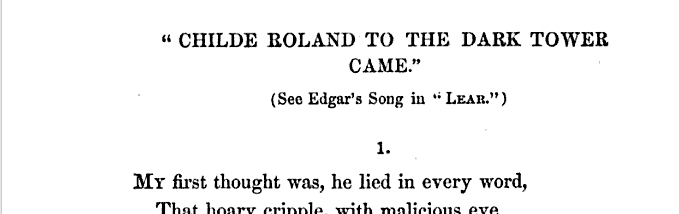
"Childe Roland to the dark tower came"comes from Edgar's song in Lear, and then is to be found again in Browning's poem titled " 'Childe Roland to the Dark Tower Came.' " Note that the quotation marks and the sentence-ending period are part of the title --
-- and that this is confirmed by the running heads in the original:
Browning's title is a quotation of Shakespeare's line, and the fact that it's a quotation matters. In Shakespeare the line doesn't rhyme; and yet it feels like a line that must rhyme in the song of which it's a fragment. At least it feels that way to Browning, whose attributional parenthesis under the title is: "(See Edgar's song in Lear.)", also with a period at the end (I could be convinced that case matters to, but I don't think that here there's any harm in the mild difference between our titling conventions and Browning's):
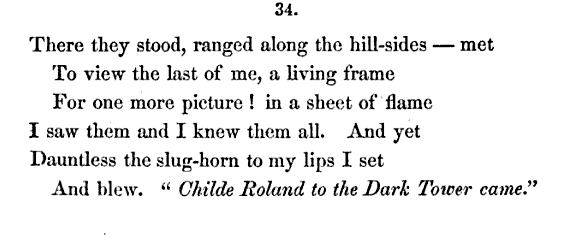
Then, at the end of Browning's poem - it's not the song Edgar is singing; rather Edgar must be singing a song based on Roland's adventure, which, Bloomianly, transumes the song - at the end of Browning's poem, we get the line in both quotation marks and italics --
-- as Roland achieves the italicized otherness, timelessness, of the original. Italics were invented by Aldus in the fifteenth century (and supposed to imitate Petrarch's handwriting, so a great authority's annotation or addition to a printed text. They stand, originally, for something that comes from elsewhere, something that doesn't belong to the original, to the utterer of the text we are reading, but to which that text is sufficiently relevant that it is entitled to demand or to entreat the italicized words. They are words granted or permitted from elsewhere. The italicized words in the King James Bible are the translators' clarifying additions, permitted, but only under that flag, by the sublime austerity of the original, its sublimity reflected in the italics that the supplementary words must display; the italicized words in quotations (italics were far older signs of quotation than are our inverted commas) were the words of another that for a moment the text wishes to display while not presuming to take possession of them. We put titles in italics to show that their title belongs to some other, that we are not the originators of the phrase. Italics and quotation marks have a similar genealogy and have leap-frogged each other in their somewhat out-of-synch history, but the point is whatever quotation marks have ever done, so have italics, and vice versa.
At the end of " ' Childe Roland to the Dark Tower Came. ' " the quotation marks are for Roland himself: here are the words I uttered. But he didn't quite utter them: he blew them (in proper Shelleyean manner) through the slug-horn, both horn and slogan (the origin of the word), so that what he blew became the self that was that quotation. And if the quotation marks are his, the sign of his breath through the horn, his utterance of words come from elsewhere, through the trumpeting of the prophecy that the words constitute, the italics denote Shakespeare, or Edgar, or Lear (the play), or the source that makes Edgar's song a quotation of a line from elsewhere. That last most of all: Shakespeare quotes them from elsewhere, and now Browing is quoting them from that same elsewhere.
What does this have to do with shortish accounts of the rhyme? Only this: that we feel the rhyme must rhyme (that's why it's from a "song"); and Browning makes it rhyme (with "flame" and "frame"), and yet the line still stands alone, rhyming with some word in a context orthogonal to the poem and to the song, a kind of signal from that other world of the rhyme we'll never know, but a rhyme that we know the line we do have nails, know it simply through the fact that Childe Roland to the Dark Tower came.
I'll want to return to my previous set of examples in a future post; here I want to start by considering one more. A naive historian of rhyme might think that what doesn't sound like a rhyme to us ("hand or eye / symmetry") would have been more natural in a different dialect or pronunciation. True we can hear eye as diphthongized (as the unlovely linguistic term has it): the slow-motion pronunciation would decompress it to "ah-ee" (the way Mark Twain or Kate Chopin might write it). That tweak would turn this into a natural rhyme, which sounds forced only to those who pronounce as we do, here, now.
But it's harder to say the same of the near parallel, and very frequent rhymes on internal "i" sounds. Shakespeare and Donne, to quote the two most obvious examples, rhyme such words as wind and mind. (The doggerel rhyme to Rosalind in As You Like It in my first example has taught generations of actors how to pronounce her name: majority rhyme seems to win, though I think it would be interesting to go with the early returns that turn out to be the minority: Ind and wind.)
From the east to western Ind,
No jewel is like Rosalind.
Her worth, being mounted on the wind,
Through all the world bears Rosalind.
All the pictures fairest lined
Are but black to Rosalind.
Let no fair be kept in mind
But the fair of Rosalind.
* * *
If a hart do lack a hind,
Let him seek out Rosalind.
If the cat will after kind,
So be sure will Rosalind.
Winter garments must be lined,
So must slender Rosalind.
They that reap must sheaf and bind;
Then to cart with Rosalind.
Sweetest nut hath sourest rind,
Such a nut is Rosalind.
He that sweetest rose will find
Must find love's prick and Rosalind.
-----------------
Go and catch a falling star,
Get with child a mandrake root,
Tell me where all past years are,
Or who cleft the devil's foot,
Teach me to hear mermaids singing,
Or to keep off envy's stinging,
And find
What wind
Serves to advance an honest mind.
Remember that Wyatt, too, knows where is an hind, though in a net he seeks to catch the wind. Nor let us forget Arlo Guthrie's great motorcycle song, which has him, as needed, rhyming pickle with motor-sickle, and die with motor-sigh- / (cul), as his folk rock pronunciation allows.
So wind/mind is okay, but you'll never find (I do not think) weened/mind, though that would seem a closer parallel to eye/symmetry or (say) we/my.
So here's the passage I want to think about, from Sidney, the octet of Atrophel and Stella 86:
Alas, whence came this change of lookes? if I
Haue chang'd desert, let mine owne conscience be
A still felt plague, to selfe condemning me:
Let wo gripe on my heart, shame loade mine eye,
But if all faith, like spotlesse Ermine ly
Safe in my soule, which onely doth to thee
(As his sole object of felicitie)
With wings of Loue in aire of wonder flie....
Note that the rhyme scheme is obvious here abbaabba. But this isn't inevitable: some of the sonnets rhyme (in their octets) abababab, and if eye can rhyme with me, it would seem that some could argue that the latter rhyme scheme governs here as well. We're facing here an example of the sort of thing that Wittgenstein ponders when he considers the problem of rule-following: there is a rule that can justify any sequence. (My favorite recent example is the sequence that begins sweetly enough as 0, 1, 2, but whose fourth member (scroll down if this isn't of tremendous interest to you) is
a number with 1,747 digits. But there's a rule for that.* Wittgenstein wants to know what makes a rule the right rule to follow, when there's no rule that could make it the right rule to follow that couldn't itself be followed in an infinite number of different ways. His answer, more or less, is practice ratified by the relationship of learning and teaching the belongs to "agreement in forms of life." Hannah Ginsborg, more or less in agreement with Stanley Cavell, calls such agreement in forms of life "primitive normativity."
Anyhow, back to our example. Sidney likes partially ambiguous forms. The famous "night and day" sonnet has only two rhyme words:
Now that of absence the most irksome night,
With darkest shade doth ouercome my day;
Since Stellas eyes wont to giue me my day,
Leauing my Hemisphere, leaue me in night,
Each day seemes long, and longs for long-staid night,
The night as tedious, wooes th'approch of day;
Tired with the dustie toyles of busie day,
Languisht with horrors of the silent night;
Suffering the euils both of the day and night,
While no night is more darke then is my day,
Nor no day hath lesse quiet then my night:
With such bad mixture of my night and day,
That liuing thus in blackest winter night,
I feele the flames of hottest sommer day.
Two rhyme words, but what's the rhyme scheme? I think it's too easy to stay with just a and b: most sonnets in Astrophel and Stella have four or five different rhyme pairs, typically rhymed abbaabbacdcdee, sometimes, e.g. the sonnet previous to this one, ababababccdeed, and again sometimes, as in the one before that, ababbabaccdccd. I think it would be better, and more natural, to "chunk" the night and day sonnet as rhymed abbaabbacdcdee: the rule of the sonnet form seems to require that.
Note that we're already chunking by taking homoteleuton (or repetition of endings) as rhyme. "Night" doesn't rhyme with "night," not even richly. It repeats the word (as in a sestina, the form Sidney introduced into English). You might almost call it a duina, at least the part that cycles night day day night night day day night. (On the relation of n-inas to prime numbers, see this short paper which proves that if an n-ina cycles, 2n+1 is prime: 5 in the case of a duina, where n=2. The converse doesn't hold, though.) In Dante, except for the repeated endings on "Christ" - which must not be adulterated by the arbitrary similarity of rhyming words - repetition is always rime riche: this is a principle of interpretation, so that you can understand an ambiguous word (such as torna, palma, and pianta, all rhymed with homonyms in Paradiso IX) as requiring difference in meaning between its orthographically identical homonyms, which can help solve the ambiguity.
The point is that in reading rhymed poetry we assess similarity pretty subtly, and assess as well the difference that prevents similarity from just being identity. Rhymes have a lot of give, but (as with stress) how much give they have is always contextualized by the rhyme scheme that determines them, and by the rhymes that surround them. Night and day rhyme with themselves because they belong to a sonnet with a familiar rhyme scheme; piante and piante rhyme because they belong to a rhyme schemes that eschews self-rhyming, so that they therefore don't mean the same thing.
And this allows us to return to sonnet 86, where we can have no doubt that the rhyme scheme is abbaabba. Why no doubt? Why not abababab? Because the prosodical context and the closeness of sound brings out, here, the difference between I and be, me and eye. Sidney takes pains to prevent our being misled by the conventional rhyming of, say, me and eye, by making sure that the first, the a, rhyme-pair is homophonic: I/eye.We then have to work to separate them via their different meanings, and that very work of separation (as in Dante) pairs them: very similar but still different.
Sidney's fearless symmetry makes sure we keep track of what's rhyming with what, even when doing so requires some involved and subtle distinction.
And here's the payoff of the always pain-in-the-ass subtlety of following a formal analysis. Making us keep track of the rhymes, especially in a fairly monochromatic context, is a way of infiltrating our sense of rhyme with a sense of meaning and vice versa. These are considerations that we're used to understanding when it comes to poetic meter, where the interaction of metrical and semantic stress contributes to our understanding of what's being said. It's interesting that there's a subtle analogue of this in rhyme as well, which suggests that the interaction, both prosodically and semantically, between rhyme and meter is closer than has usually been suspected.
-----
*viz., 0 followed by 0 bangs = 0; 1 followed by 1 bang (1! or 1 factorial) = 1; 2!! (2 factorial factorial, 2 followed by 2 bangs = 2; 3!!! (3 factorial factorial factorial) = 720! = the foregoing.
One thing that fiction makes possible, and that makes fiction interesting, is the way it can show how what feels, in real life, like a simple and unified interaction with others occurs on several channels at once. Fiction mutes some of those channels, and therefore focuses our emotional attention, our attentive emotion, on those that remain. And it focuses the theorist's attention (as here) on the differences between those channels that remain open and those that are muted.
For example: in a play we and several hundred other people in an audience can be in the presence of a character who is entirely alone. The channel of their presence to us is open; the channel of our presence to them is muted (although not entirely). At a movie we can hear everything that one lover whispers to another in the absolute privacy of some erotic sanctum. (Our presence to the characters is completely muted, though our presence to the actors only partly so.) The way these figures are present to us when we are not present to them is what I mean by the separation of one channel from another. Usually, in the real world, presence is a commutative relation. If I am present to you, you're present to me. (Even sleeping isn't a counterexample: If I'm asleep and you're awake, neither is present to the other.) But in fiction this apparently axiomatic double relation is no longer one (that is what makes it fiction).
This general idea allows us to see that first person narrative, at least since the nineteenth century, will frequently involve a narrator presenting herself to us in written words that she has never been supposed to have written. The written words are the way she's present to us; her never having written them is the way we're not present to her, since she never addresses us in her world. The channel in which her words exist is the channel we receive on, not the channel she receives on, even if she's writing.
It might be useful to establish a couple of preliminary distinctions in our vocabulary to help keep us clear on this issue. First, distinguish between a true first person narrator and a false one. What I am calling a false first person narrator is really just another character (focalized as much as you like) whose utterance a third person or omniscient narrator reports. Clarissa reports the letters that it collects, and all the first person narrative in those letters may be thought of as quoted discourse. (The true first person narrator of Clarissa, the narrator who addresses us or such as us, is the putative editor of this correspondence.) Poe quotes the full MS that Arthur Gordon Pym has written. But Ishmael addresses us directly in Moby Dick. We can then establish a pretty strong boundary (it's not absolute, but its breach, as in Proust, is always interesting) between what it may be useful to call true narrators and reported narrators.
Let's also distinguish between a character (in the sense of personality) and an agent. Usually this distinction will count most when applied to a true narrator. The narrator will do things in the work she narrates, will be an agent in that narrative (interacting with other agents, as, for example, when Nick brings Daisy and Gatsby together). Insofar as she does that, she's an agent as well as a character or personality.
All agents are characters but the two terms are not synonymous. We can separate off the idea of character by noting that part of out sense of her as a character (part of the fiction's presentation of her as a personality) is established or nuanced or complicated by what she says to us, even though she does not say these things in the world she lives in, wholly lives in, as an agent. The shocking moment that Nick talks of Gatsby's "appalling sentimentality" tells us much about Nick, but doesn't affect the plot of the book.
So a narrator's tone, judgment, voice, expectations, and so on, all affect our sense of the narrator as a character and so also affect our sense of the narrator as agent, even though these things do not belong to her as an agent within the fiction.
This leads to interesting and I believe somewhat unexpected insights. I've noted elsewhere how interesting it is that despite the fact that we can make the distinction between narrator and agent it's not quite absolute. It almost always seems to violate fair play to have a true narrator die (as in Susannah Moore's Whiteness of Bones [highlight if you don't mind the spoiler: not a great book, but still]). Ishmael must escape to tell us, even if he doesn't tell us as an agent. How else could be be narrating? It doesn't matter that we don't expect the narrator to have ever written the words we read, perhaps none of them. We still require that the voice which addresses us belongs to a character (NB: not to an agent) who is still alive, still exists, still can speak. Usually, in a written text, we require that it belong to a literate character, one who could write what we're reading. (Norman Rush's dialect works may provide a counterexample, but it's also possible that we process works narrated in a dialect we know not to be the author's as narrated by what I called a false first person narrator.) The Murder of Roger Ackroyd offers more to think about: the narrator just sounds too different from the agent designated by the same first-person pronouns for everyone to feel comfortable with the trick Christie plays. True first person narration occurs in some modal, subjunctive world.
Not, though, a possible world: the point is in no world does the frue first-person narrator actually write the narrative. We see no contradiction in such last sentences as: "She asked me to promise I would never tell anyone any of this [what we've just read], and that's a promise I'll always keep." But in no possible world could that sentence seem innocuous. It always and knowingly bridges two worlds (as Lewis says we mustn't).
Borges's "Secret Miracle" is relevant here, at least as an emblem of what I mean, or perhaps its reciprocal converse. The miracle is the work; the secret is its non-existence in the world in which it's written.
I'll note one minor but interesting effect of this muting of full commutative communication between fictional addressor and us real addressees: It makes a certain kind of boasting possible. Richard III and Iago, in their various soliloquies, rejoice in being able to act like the "formal vice, Iniquity," rejoice in their own cleverness, in being tricksters. Had they boasted as agents, in the worlds they inhabit, they would, by the laws of narrative (in our culture anyhow), inevitably fail. Boasters get shown up. Soft-spoken understaters surprise.
But the boasting they do is not boasting in their world. They boast to us, not to their compeers. And so they are setting forth the parameters of the challenges they will meet, doing it for us. The magician's relish they take in difficulty is something we need to know. It wouldn't work in their world, but it does in ours. The difficulty and boasting are present to us, but not a presence in the world they inhabit.
Since I think this situation, this non-commutative presence, is the key issue here, we can say that all these moments: narration, boasting, the privacy and unawareness of figures in fiction, are paradoxically enough, versions of the same thing. Richard's boasting and Isabel Archer's silent thinking are really different manifestations of one relation to us.
Note:
It's no wonder if this seems like our beliefs about our parents' attitude towards us. For in real life, that non-commutative relation to others is what the child believes about its parents. I am not fully present to them. They transcend me. Yes, they sometimes ignore more and sometimes boast to me and sometimes rebuke me and sometimes tell me about themselves. But in none of those cases am I interacting with them in the world they truly live in, as agents. All the evidence that they give me of being focused on me is worth as much or as little as the evidence that fictional agents give of being aware of me. Fiction is possible, in part, because it repeats a relation we have to those greatest of fantasy figures, the actors in the family romance of which we are in the end spectators (so we think). And fiction shows how the family romance can work, through the separation of those things that serious adults, living real lives among real people, forget don't always come together, not, anyhow, in the awe-struck, humble eyes of the child, all absorbed in the fantastic world it is not and cannot be part of.