Showing posts with label Newcomb's Problem. Show all posts

Sunday, October 23, 2011

Lewis on Fictional Worlds

My friends assure me that D.K. Lewis was completely serious about his belief in the real existence of possible worlds. For me they're a useful heuristic, but I guess it helps to go whole hog, since to do that commits you to a more robust view of truth: it really is true in a possible world that something possible happened although it didn't happen here.  Lewis's idea makes truth more robust by shifting the adjective possible from modifying truth to modifying a set of worlds.  Then not only are possible things true in some worlds, but it is true, pure and simple, that in all worlds taken together every possible thing is true.

Which can be a depressing idea, depending on the vividness of your imagination, and depending also on your views of counterparts and zombies and the like.  (I myself would want instead to assume that all my counterparts are zombies, and that I escape death at every moment by threading the maze of worlds where my counterparts, are, at every moment, dying.  I could believe in a kind of asymptotic immortality this way, or a kind of perpetual standing wave of reincarnation into some still-living version of myself.  Or, really, a kind of packet-switching of the entity or identity consisting of myself plus all my zombie counterparts; me, I'd always exist in one of the packets getting through to the future, and not in the packets that weren't.  This suggests, by the way, a reason to be a one-boxer: I want to live in one of the one-box worlds.  Lewis, a two-boxer, himself admits that the one-boxers would do better than he would, as a matter of fact.   He'd still pick one box though, since that couldn't causally change his outcome.  But to resume the thread of my discourse....)

If Lewis is serious, and if he's right, he would justify, and also give a spooky and discomfiting authority to, a kind of literary fiction (and fan fiction too) which it's harder to justify if there's just one world, "la vie, la seule qu'on a." Here's how Lewis says we should think about fictional worlds:
The worlds we should consider, I suggest, are the worlds where the fiction is told, but as known fact rather than fiction.  The act of story-telling occurs, just as it does here at our world; but there it is what here it falsely purports to be: truth-telling about matters whereof the teller has knowledge.
Lewis doesn't say why the fiction has to be told, perhaps because he thinks it's obvious: the world of the fiction is one in which the events occur and in which the fictional narrative also exists, since it is, at least implicitly, part of the fictional narrative that it exists.  Now, I myself don't think that it is an implicit part of a narrative that it exists in the world it purports to describe, for reasons I've mentioned in previous posts, but I don't think this actually matters very much for Lewis's view.  I'll note though that he does seem to worry a similar issue at the very end of the essay, when he raises a question about how to treat a fictional character who in the fiction is telling a fiction. But I think all we need to accept is that any consistent fictional world, as long as it is possible, really exists somewhere. Some of those worlds will indeed include true accounts of the events in the world that are counterparts of the fictional accounts of those events in our world.  But I don't see that they need to. (In fact if they did need to, it would seem that there might be an infinite regress to worry about, since we'd have to add to any narrative that it is a true account of the world, which would change it and require another such assertion, etc. Lewis seems to prefer to go the way of collapsing iterations rather than allowing for this infinite regress, but sees the collapse as problematic too, since now it would be hard to keep separate fiction and the things that are fictional within that fiction.)

So every consistent and possible fictional world really exists, somewhere.  Then the work of the writer of "realistic" fiction (where realistic means something like "possible") is a kind of discovery of truth, the truths consistent with the writer's possible and therefore true premises.  It's like math, or like chess, or like their intersection: given a possible state of affairs, here is an array of incidents, events, characters, interactions, and outcomes consistent with it.  Since possible states of affairs are all of them true somewhere, so are all the incidents, event, characters, interactions, and outcomes consistent with them.  The fiction writer discovers truths which we might be glad to know, or be horrified to know.  But they are true, somewhere (unless you go my zombie route, in which case their truth won't matter as much: they'll just really be avatars -- in the gaming sense, not the strongly counterpartial sense in which they'd have something of the meaning they have as reincarnations - coincarnations, perhaps, of real souls.)

So reading fiction is reading about something that's true somewhere.  If there are inconsistencies, then your reading about multiple truths, all of which may obtain in different places, even if not simultaneously.  And the kind of literary criticism so popular a century or so ago, where critics hazard and argue for strange back-stories: all that's true too.  Hamlet was a woman (in many many worlds, in all the worlds in which she existed); was Claudius's son; was his daughter; was old Hamlet's murderer.  Desdemona did betray Othello with Cassio (in many, many worlds), and Emilia did sleep with Othello in many of them.  Fan fiction consistent with the authoritative fiction it riffs on is all true too, somewhere.

Yes, all consistent fan fiction is true, and all consistent back-story mongering is true, but I am making a stronger claim than that.  It can be, is somewhere, true of our Hamlet, our Desdemona, that is to say, Shakespeare's Hamlet and Desdemona, if it is (possibly) consistent with what we know about them.  But if it is consistent with what we know about them, well then these are things that are true, and true in possible worlds as close as you could want them to be to our own. ("Closeness" of possible worlds is how Lewis handles overall resemblance or divergence between worlds.  The worlds in which Hamlet has three eyes and is green are farther from us than the worlds in which he looks like Jude Law.)

Maybe literary critical arguments are another way of arguing for or against closeness of possible worlds. "Only an idiot would think Claudius was innocent" really means "The possible worlds in which Claudius is innocent are each much farther away than its almost perfect replica where he's guilty."  Maybe.  But that world still exists, and that story, that solution to the chess problem the play presents to its critics, is still true.

If Lewis is right, just imagine the Sartrean seriousness of the responsibility of the critic, or the fan-fictionist, or any audience member guessing at what happens after the story ends.  It's not that we cause those worlds to exist by imagining them.  It's that we come to know that they exist, and whatever claim those events have on our emotions is a claim we now can't dodge.

Writing would be like writing on an Etch-a-Sketch or frosted window: we expose fragments of what's behind it in our writing, and then can't unlearn what we've learned.  As pure epistemological beings, we can know in theory that all possible things are true.  But as empirical humans, the true things that we learn explicitly about have a very great claim on our attention and care, our Sorge. Which suggests we should be cautions about the truths we learn through exposing ourselves to fiction, or through exercising our own imaginations.

Luckily I can't believe any of these possible worlds are real, as the possibly still living and thus-believing Lewises do (or as our this-worldly Lewis was said to).  But it's possible that they are.  And then all you could do is hide.

(The whole thing is Lemian or Borgesian. Lewis would be committed to think, I am sure happily, that the whole Library of Babel really existed, extensionally. For Quine, the whole library may be found condensed, amply, in the alphabet.)

Monday, September 12, 2011

Time and the Other in Proust and Shakespeare, part II

“Father!” “Son!” “Father I thought we’d lost you
In the blue and buff planes of the Aegean:
Now it seems you’re really back.”
"Only for a while, son, only for a while.”

                                                               --Ashbery
What does awkwardness really mean (to continue my previous post)?

Say that what drives a scene in fiction, in any fiction, is some encounter which counts, an encounter that starts something going, introduces a tension. Or it resolves a tension, brings something to a close.  So the awkwardness I ended my last by invoking is an encounter that does... nothing.  It doesn't count for anything beyond its own discomfort. The dreaded or dreamt of moment doesn't change things, except to erode our sense that anything can change this unresolved relationship anymore, that anything will change it.  We've had, like another, our story ("Elle avait eu, comme une autre, son histoire d'amour." --"Un Coeur Simple").  And then what?  Not much. Because all of that's now in the pluperfect, and what's left, one way or another, is intermittent awkwardness.

I think psychoanalysis is supposed to teach you to accept awkwardness, to stop expecting that transferential relations will allow you to make up for the past.  Think of the awkwardness of meeting your shrink later in life (or teacher or coach or whomever).  For psychoanalysis that's the goal: "the ordinary unhappiness of everyday life."  You come to accept awkwardness, intermittence and all, not as a local accident, but an ontological condition, the only form of ontological possibility left.  It's a kind of genuinely resigned hopelessness, hopelessness which doesn't retain the hopefulness, the desperately energetic willing, the exigent need to be wrong, that is part of the grammar of the word hopelessness, part of what that self-description conceals and cherishes.  Awkwardness is hopelessness without hope.

So I don't mean the awkwardness we feel early in life during the so-called awkward age: a form of intense transference onto the person one's awkward before: "I am shy, bring this right, make it happy." I mean posterior awkwardness: if and when this awkward moment is over, that will be a middling improvement, a reversion to the mediocre.  That's what we fear in the awkward age, but what comes true later in life, and isn't even worth fearing. And, writers like Henry James (think of Caspar Goodwood's ridiculous, pointless return to Isabel Archer) or Cormac McCarthy keep showing, this kind of awkwardness occurs at the level of a life or even of history.

Thus, at the end of Blood Meridian, the Kid (a kid no longer) meets the Judge again, having escaped the fate the Judge threatened him with when the Kid was still a kid.  He escaped that fate for a while, anyhow.  But now the Judge is back, and to the Kid's penultimate outburst -- "You aint nothing" -- he responds, "You speak truer than you know."  The Judge is the embodiment of Nothing; he is Marías's "Sir Death" (Marías' English phrase in Tu Rostra Mañana; he claims to get it from medieval English drama but I certainly can't find it).  Like Sir Death, the Judge is the narrative opposition to all narrative possibility, to the bargaining that makes narrative. He doesn't bargain. Nothing is remembered, nothing escapes obliteration. The Judge and Sir Death stand for narrative impossibility, the complete and utter end of the story.

It was inevitable that the Kid should meet the Judge again (the Judge dances and he is everywhere and he will never die), and that no escape can shape the story's end.  That's the Judge's final lesson for the Kid:
A man seeks his own destiny and no other, said the judge. Will or nill. Any man who could discover his own fate and elect therefore some opposite course could only come at last to that selfsame reckoning at the same appointed time, for each man's destiny is as large as the world he inhabits and contains within it all opposites as well. The desert upon which so many have been broken is vast and calls for largeness of heart but it is also ultimately empty. It is hard, it is barren. Its very nature is stone.

He poured the tumbler full. Drink up, he said. The world goes on. We have dancing nightly and this night is no exception. The straight and the winding way are one and now that you are here what do the years count since last we two met together? Men’s memories are uncertain and the past that was differs little from the past that was not.

He took up the tumbler the judge had poured and he drank and set it down again. He looked at the judge. I been everywhere, he said. This is just one more place.

The Judge arched his brow. Did you post witnesses? he said. To report to you on the continuing existence of those places once you'd quit them?

That's crazy.

Is it?  Where is yesterday? Where is Glanton and Brown and where is the priest? He leaned closer. Where is Shelby, whom you left to the mercies of Elias in the desert, and where is Tate whom you abandoned in the mountains? Where are the ladies, ah the fair and tender ladies with whom you danced at the governor's ball when you were a hero anointed with the blood of the enemies of the republic you'd elected to defend? And where is the fiddler and where is the dance?
No witnesses but the Judge who witnesses in order to obliterate (as we learn in an early scene).  There is nothing and no one left to show that Shelby or Glanton or Brown or Tobin (to quote Marías again) "trod the earth or traversed the world" before ending up in "one-eyed oblivion."

So let's say, then, that this is Cormac McCarthy's view of tenses : "The past that was differs little from the past that was not" (his view of punctuation is for a later post).  Then the end of Blood Meridian, despite all of McCarthy's contempt for Proust, and presumably for Flaubert, is not essentially different from the end of that other helpless, hopeless coming-of-age novel L'Education sentimentale (the Kid too knows the melancholy of waking up in tents).  The Judge's words gloss that ending: "The straight and the winding way are one and now that you are here what do the years count since last we two met together?"  This is Holden's version of Flaubert's tremendous blank.

The straight and winding way end at the same place.  Dickinson knew this, knew that Shakespeare knew it.  "Since Cleopatra died," says Antony, "I have lived in such dishonor, that the gods / Detest my baseness."  She died, he thinks, moments ago, and so he too has invented a new tense: the passé composé of perfect difference from the past.  "That engulfing since" Dickinson calls it.


But Cleopatra hasn't died.  Unlike Romeo and Juliet, Antony and Cleopatra are to see each other again, to speak to each other again.  The forlorn hope of reunion comes true.  Their way to death is more winding than they think.  And yet, like Ashbery's skaters, they are only elaborating their distances to a common and inescapable end.

I remember reading a study which graphed anxiety about medical tests against the likelihood of their coming out positive (likelihood of bad news, that is).  Essentially as you get older, your anxiety about any specific test decreases, even as the likelihood that what you're worrying about actually will be true increases.  You get less anxious (you get used to the routine, you become less of a hypochondriac), but the negative results become more and more uncertain.  You're pretty confident, maybe too confident, that this test will come out negative.  But what about the next one? How much good does it do you to get this negative result? Considering the alternative, a lot.  But life becomes more and more filled with the sense of a temporary reprieve, not a happy ending.

"Every catching of the breath / Is the sickness unto death" writes John Bricuth in his great poem "Hypochondria as the Basis of Conversion," each stanza of which ends with a Kierkegaard title.  In fact hypochondria of the soul increases as you grow older.  Every crisis of anxiety passed only brings you deeper into the world of crisis.

In Shakespeare the worry is not hypochondria but anxiety about other people, about love and loss.  A Midsummer Night's Dream ends in blissful ignorance about the coming disaster: that "the issue there create," in Theseus and Hippolyta's bed, will lead to Senecan tragedy.  So too Henry V ends the second Henriad with hopeful marriage, Hal and Kate's happiness undimmed by what we know is coming, the scene that takes place only a year or so later, and which Shakespeare wrote ten plays or so earlier at the beginning of The First Part of Henry VI.  Marriage is about everything's working out.  The fact that nothing works out for good is beside the point.  For the young.

But the parental generation (the later Shakespeare's generation) is always aware things work out only for a while, son, only for a while.

For "the worried well" (to go back to hypochondria for a moment), the equivalent of things' working out is the negative test result.  That's what we want: let it be negative this time.  As we get older, we know the positive result will come.  But we bargain: let it come later, but not now.

Heidegger (as John Limon points out) -- the early Heidegger, anyhow -- had contempt for this kind of bargaining, which he thought characteristic of "They-being," the mode of being of the fearful evaders of truth who cannot attain an authentic being-towards-death.  Kierkegaard thought of this sort of bargaining as one of the kinds of despair

But what I'm interested in here is narrative, not the anti-narrative stance of being-towards-death.  Narrative is about bargaining, and the question is what you get out of the bargain.  In life, and in narrative that seems adequate to our experience of life, we start out bargaining for some quit-claim, but later on what we want, what we know as the only possibility, is deferral.  Let the moment be awkward, not final.

Sure, all bargaining, in even the most naive stories, can involve characters' deaths; it often does, but death there means a bad narrative outcome, which we'll accept, if we have to, along some of the byways narrative takes as long as we get what we want at the end of other pathways.  Babar's mother, Bambi's: they die.  Little Paul Dombey may die, if he must, but then their father had better give Florence the love she needs and deserves.  And we do have to accept the bargain.  We have to accept the fact that we're bargaining if we're to participate (as we do) in any narrative experience beyond pure wish-fulfilling daydream: the interest, the emotional involvement in narrative comes from the bargaining and negotiating we put our souls into.  (It's characteristic of Shakespeare's generosity in the comedies, by the way, that at the end he tends to throw in some added gift we hadn't bargained for.)  If we could get everything we wanted, we wouldn't be bargaining; narrative experience is the experience of bargaining, ergo we can't get everything we want.  One of the manifestations of what we don't get may be death.  But death here just stands for an element of the bargaining outcome, where what's important is the bargaining.  At least in most narratives.

The bargains we make with narrative are often more gratifyingly framed versions of the bargains we make in real life.  We worry, and we are willing to give up some of our happiness in order not to lose it all.  We think in terms of negotiated satisfaction; we signal our willingness to accept lesser but still saving and even gratifying states of affairs.

(My mother was once very anxious about where my father was - he was terribly, unaccountably, uncharacteristically late.  The phone rang and it was the police!  They identified themselves and made sure who she was.  Then: "Your husband's in jail."  Her response: "Oh, thank God!"  Because he wasn't dead.  [He'd cussed out a cop who had pulled him over for speeding.]  The phone's ringing, and I'll accept a compromise: bad but not terrible news.  I'm a reasonable person, a serious man.)

Tragedy and comedy represent two different bargaining equilibria: we give up a little in comedy to get a solution we're satisfied with (maybe even a better solution than we ever expected: we get a surplus reward).  We give up a lot in tragedy to get to a solution that at least leaves us calm of mind, all passion spent.

I think Aristotlean unity is about the straightest way to whatever equilibrium is achieved.  (There's a reversal, yes, but the reversal is the start of that straight path.)  Shakespeare is interested in the winding ways.

And this is where things change, this is where he thought his way through to a new narrative representation of real experience -- the representation later to be found in Flaubert and Proust, e.g.  In his later plays, the winding ways become more and more his subject, and not only the itinerary of its exposition. Romeo and Juliet part, never to converse again.  But in the later plays, look what happens: Lear is reunited with Cordelia! Antony with Cleopatra! The Macbeths reign for a long time, longer than they ever dared to hope: everything they sought they get, except the immortality they never believed in anyway.  And then, there's the original for Dombey and Son, The Winter's Tale.

Mammilius, a senex puer like Paul Dombey (and Miles), has to die, but for that loss we get the recompense of Perdita's happiness, and the reunion of Hermione and Leontes in overplus.  And yet, they're old. The play begins with a lamentation over lost youth: how much more lost is it at the end!  The happy ending of the play isn't the real, true end, final end of everything, but that final ending isn't far away from the parental generation there.

I think what Shakespeare was thinking about more and more was the way all our real-life bargains with fate (or life or God) become modes of temporizing, seeking extensions on the loan, a raise of the credit limit, not the impossible forgiveness of the debt.  As we become aware of time in the Proustian, Flaubertian sense - as we become aware that the future is continuous with the present and not something whose existence is absolutely deferred (which is how we thought of is as children) - we become aware that all that our bargaining achieves is, at most, renewals on harsher and harsher terms and for shorter and shorter periods of the crushing debts we owe.  There is no happy ending for Antony and Cleopatra, or Paulina and Camillo (far from it) or Lear and Cordelia or the Macbeths, despite their unexpected reunions. The Kid can escape Judge Holden for years, for as long as he could possibly hope for, and yet he cannot escape.

We bargain and bargain and usually get the extensions we want; we usually get more than we'd allowed ourselves to hope for. Usually. Until we don't. It's all okay! Until it isn't.

That's what's awkward about getting the terms of the extension.  It's the awkward gratitude you express to the debt collector for giving you another month.  The awkward fact that we can more or less clumsily affect not to notice, in order to save the moment, is that the debt is still due, and harder to pay than ever. Maybe we can save the day. But only the day. How awkward for the poor servant to meet Death in the marketplace in Baghdad.  But the man manages to get out of the situation, and lives to keep his appointment in Samarra.

And it seems that for Proust, maybe for McCarthy, the only cure for that is remembering, which is to say writing - being lost in another world.  But is that a cure that lasts? How long?  A lifetime? Why did Shakespeare stop writing?

[A bit more on Proust, in my next which will be, I promise, shorter.]

Friday, June 17, 2011

Film, will, and the paradox of imperceptible differences; or Body English

There's an interesting philosophical problem about the nature of imperceptiblity, related to the problem of sorites (at some point a baby stops being a baby: when?).  I thought I'd post my ideas about this, partly prompted by a recent and somewhat cantankerous essay by the great David Bordwell, with which I agree with in part and disagree in part.

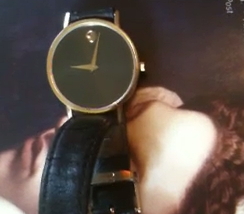
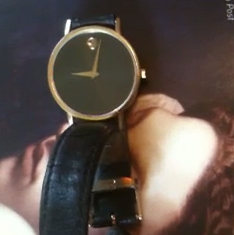
Consider four photos of the hands of a watch, taken at, say, 1/24th of a second apart.  Put them in front of someone and ask her which one was taken first:


I didn't manage to crop these quite the same (that's an issue we'll come back to: changes in the perceiver's or recorder's perspective), but just look at the hands of the watch.  These shots were taken within about a quarter of a second of each other, so on average they're about 1/12th of a second apart - twice the 1/24th of a second we're hypothesizing.  I present them here randomly (I followed the order of the last four digits of my Frequent Flyer number).  Can you tell the order they were taken?  (Answer: The order is 4,1, 2, 3 - I think you can just make the sequence out if you squint, but if not, highlight all and you'll be able to.)

At some point, though, you'll be able to see that the hands have moved, that it's now (more or less) 9:03 and not 9:01.

So the paradox of imperceptibility is this.  Let's say call p the minimal distance that the hand of a normal-sized watch has to move for us to perceive -- by eyeballing two different life-sized photos -- that it has moved.  The order of magnitude for p here is probably something like twelve minutes of arc or so (for the big hand that would be about two temporal seconds, for the little hand two temporal minutes).  At any rate, the photos above don't show anything like a difference of magnitude p.  We're talking about a total of a quarter of a second here, which is why there's no way you can tell the order by looking.  (Funes could, I suppose.)

Now consider two photos identical except in the second of them the minute hand is at a distance of 1.6p from the first; i.e. 3.2 seconds have elapsed between the two photos. Just looking you can tell the difference!  (Remember that's what p means: the distance greater than which you can see the difference.)

Now imagine interpolating a third photo, which shows the minute hand at a distance of .8p past the first photo, and accordingly at a distance of .8p before the second photo; i.e. this third photo was taken 1.6 seconds after the first, and 1.6 seconds before the second.  In other words, let's assume we're looking at a sequence of three photos, taken 1.6 seconds apart.

So here's what exercises the new Zenonians.  You can't tell the difference between the first and the second photo (we've stipulated that the minimal difference you can tell is p, the distance it takes the minute hand two seconds to cover), nor can you tell the difference between the second and the third, but you can tell the difference between the first and the third.  So you perceive no difference between the first and the second, and no difference between the second and the third, and yet, somehow, somewhere, you must perceive some difference or you wouldn't perceive a difference between the first and the third.  (There's a strange failure of the transitivity we expect here.)

To see how this is true, consider ordering the photos to present them to someone else.  Since there's no perceptible difference between the first and the second, you should be able to switch them around, and no one will be the wiser.  But if you do that there'll be a perceptible difference between the new second and the third.  You can't see the difference between one and two, so their order seems not to matter; but switch them and you can now see a difference between two and three, so their order did matter.

That's the problem.  People have tried to solve it with vague appeals to threshold differences, but the new Zenonians point out that this is just to rename it, since the whole point is to ask what makes something exceed the threshold of perceptibility.  P defines that threshold, but we've already said that.  An appeal to a threshold only changes the vocabulary.

Here's my solution.  Look at any two indistinguishable photos whatever: even at the same photo twice.  There'll always be a perceptible difference between the two.  Your head will have moved slightly, the light will have changed, your eyes will have performed some micro-saccades, the beat of your pulse will cause the image to shudder, your breath will inspire it to fitful and inconstant motion.  But you'll read the two different retinal images as identical, because part of visual processing consists in abstracting from the incessant flux of experience by fixing on what J.J. Gibson called invariants.  The brain uses these invariants (edge ratios, color ratios, etc.) to calculate what's changing in the world vs. what's changing in your perceptual apparatus.

Accordingly, we're always testing the origin of the perceptual changes that occur every moment. This is an argument that Kant was the first to make, as he analyzed the nature of our capacity to distinguish between seeing a boat move downstream and a house standing still.  Both visual experiences come to us through the incessant flux of appearance: I see a window, a door, a lintel, an eave, in any order; or I see a prow, a stern, a sail, an oar.  But I am proprioceptively aware of the fact that the flux in my view of the house comes from movements I am myself making, that originate in my own will.  (William James argues that the difference between proprioceptive awareness of unforced change and the experience of willing is essentially nonexistent.)  The flux in my perception of the boat isn't assignable only to my own will.

At some fairly automatic level our brains proprioceptively track our microsaccadic eye-movements and assign the origin of the flux we see in an unmoving object to our own movements.  At some point we'll begin to wonder whether, and at a later point decide that, we're seeing more flux than we can explain through our automatic proprioceptive guidance systems.

Vertigo provides an obvious example of this fact.  If we mess with the vestibular system (by spinning around, by drinking), we lose a very important proprioceptive clue as to the attitude of our heads.  Now we're reeling and seem to stand upon the ceiling: the room is still but we think it's moving.  Closing your eyes helps because you stop seeing the motion that they're making, stop projecting it into the world.

So no case of motion may be absolutely assigned to one domain or the other, to the world or to the seeing soul.  But usually we start with a very good guess as to where the motion is.  This also explains a feature of vertigo: the way we cast our eyes everywhere trying to find something that will stay still to orient ourselves by.

Imperceptibile motion, then, is motion whose perception is swamped by the normal flux of appearance.

Consider the converse idea: that of imperceptible stillness.  I feel as though I've been waiting for this class to end forever.  Has the clock stopped or am I so bored that every minute seems five?  I keep looking at the clock, and after a while, I start realizing that it's broken.  It's frozen but I thought it was moving.  I decide that it's frozen in several stages: I wonder, I concentrate, I observe closely, I wait a little longer, and after a while I make a judgment: it's not fucking moving.

Likewise imperceptible motion occurs when I think something is still (when my automatic visual processing takes something as still), but then after a while start wondering if it really is still.  I am not sure the flux derives only from myself.  I start testing the hypothesis that the minute hand itself has moved.  That hypothesis is easier to test the more it moves.  Nothing makes it certain that the motion comes from the world, and not from me, but I become more and more confident that certain intervals are more likely to be due to a change in the object than to a change in my own perspective.

Body English -- you know, as with Carlton Fisk's stay-fair home run -- provides a vivid example of what I mean: you move your own body to some extreme angle to get a preferred perspective on the ball.  Of course you know that this doesn't affect its trajectory, but you can fool or try to fool your perceptual apparatus into thinking that the change you see is a change in what you're seeing, not in yourself.

The fact that perception always involves the will, gyroscopically orienting the telemetry of the senses, means you can dally with false surmise by flooding the proprioceptive stabilizers of perception a little bit.  We can pick the locks of perception (by spinning around or crouching and cocking our heads or whatever) and so perceive a little more wishfully than accurately, when we really want to.  This shouldn't be surprising: it's the will after all that's being engaged.  We move in certain ways because we want certain things to happen, and our motion sometimes affects the world (and so our perception of it), sometimes just our perception of the world.  The fact that we engage so much in body English shows that the frontier between what our brains think comes from outside and what they think comes from inside is porous and vague. The two types of willing are continuous, no doubt because all perception requires the same sort of experimental assessment of how (or whether) it's going as action does. A single way of doing that experimental assessment governs both cases, and can turn one into the other.

Film depends on this fact about impercetible motion, in more ways than one.  Two frames, 1/24th of a second apart, will often be indistinguishable.  (Not to Fred Astaire, apparently, who'd fiddle with single sprockets in his movies, to get the beat exactly right.  I believe the technology was eight sprockets per frame when he made his great movies, so that would mean he was able to perceive differences at about 1/200th of a second.  But no one had more motor control, and therefore more fineness of proprioception than Astaire.)  But of course over eight frames you can see any perceivable motion - that's a third of a second. So when we watch a movie, we're brought to judge motion as imperceptible differences - differences we would ascribe to the noise of the perceptual system - make themselves felt as perceptible.

But that means that we're constantly judging what we're seeing, through the engagement of our will.  In well-edited films, the films themselves will, through what we could call cinematic occasionalism, conform to our own acts of willing.  Someone looks right.  We want to see what they're looking at.  The camera or the editor obliges.  In classic Hollywood film the audience almost always feels in control of the camera.  (The times that we don't, at least in a good movie, are generally the places where we feel the pleasure of being played: think of any Hitchcock film.)  Film, and classic Hollywood film especially, exploits our negotiations with our own perceptual flux, and engages our will in ways that minister to narrative desire, to the body English that makes us try to see things as acting the way we want them to act.

I think that what we have here is a natural analogue to Newcomb's Problem.  By choosing our perceptions right, we may be able to get what we want.  If that's how the psychology of narrative works (through the general phenomenon that I call non-causal bargaining), then on every scale, from 1/24th of a second to two or more hours, our relation to film keeps our occasionalist testing of what we see highly sensitized and engaged.  This would make film a particularly apt medium for narrative engagement (probably just about as apt as language, where I think we do a similar sort of testing).

Obviously I wouldn't confine this to Hollywood movies: Chatal Akerman's Jeanne Dielman, 23 quai du Commerce, 1080 Bruxelles is a case in point: we watch Jeanne over three days and start noting the tiny differences in what she's doing.  Are they artifacts of film making or are they action?  That's the question that animates our perception of the movie.

The perception of all action requires our involvement, and the more our involvement is fictional or factitious, even on the level of the most basic perception, the more it enmeshes our willing and our wishing, our desire and our engagement in non-causal bargaining.