Showing posts with label Browning. Show all posts

Thursday, August 31, 2017

David Lewis, uses fictional worlds as a way of exploring the idea of the proximity of possible worlds, but confesses he's not quite sure what to do with fictions within fictions.

One thing some writers have done is to write the actual (our-word) fictional work that some fictional work only mentions.  They give it to us for our use.  (This is the converse of the sort of thing that Borges and Lem do.)


A few such useful texts spring to mind right away, in chronological order:

Prencipe Galeotto: Dante has Francesca say of the book she and Paolo are reading together when they stop reading, "Galeotto fu 'l libro e chi lo scrisse."  So Galeotto -- Prince Galahad (perhaps; it's not clear whether Dante identified Galeotto and Galahad), vicariously catalyzing their mutual seduction -- is both the author and the book itself. Boccaccio gives the Decameron the sub- or alternative title Prencipe Galeotto, making it into the book that Paolo and Francesca were reading, and promising it as a conversation piece for later lovers to seduce each other with.

Spenser completes one of Chaucer's Canterbury Tales, the Squire's, in Book IV of The Faerie Queene.  (Spenser takes it as complete -- a real thing that Chaucer mentions, but that we don't have.

"Where is the Life that Late I Led?"  Petruchio interrupts himself after he starts singing this song in Taming of the Shrew.  Cole Porter gives us the whole song (with a bridge and a slight modification of Petruchio's second line).
"Childe Roland to the Dark Tower Came": Browning writes the poem that Edgar quotes in King Lear.
The Transfiguration of the Commonplace: From Muriel Spark's Prime of Miss Jean Brodie, the book that Sandy Stranger writes when she becomes a nun (Sister Helena). Arthur Danto (not Dante!) then wrote a book about the philosophy of art with that title.
The Secret Goldfish: D.B.'s "terrific book of short stories" in Catcher in the Rye, and the title of a book of short stories by David Means.


Can you think of others? 

Tuesday, March 20, 2012

Rhyme and meter, part 4b: Childe Roland

The second in a series of fairly frequent, short(ish) followups to Part 4 in this series.

"Childe Roland to the dark tower came"comes from Edgar's song in Lear, and then is to be found again in Browning's poem titled " 'Childe Roland to the Dark Tower Came.' " Note that the quotation marks and the sentence-ending period are part of the title --
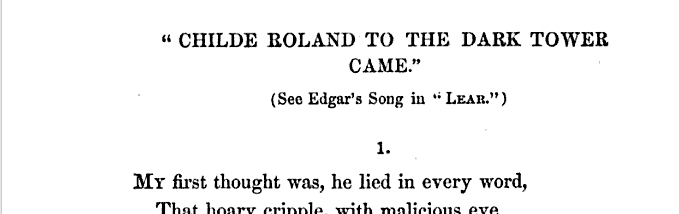


-- and that this is confirmed by the running heads in the original:



Browning's title is a quotation of Shakespeare's line, and the fact that it's a quotation matters. In Shakespeare the line doesn't rhyme; and yet it feels like a line that must rhyme in the song of which it's a fragment. At least it feels that way to Browning, whose attributional parenthesis under the title is: "(See Edgar's song in Lear.)", also with a period at the end (I could be convinced that case matters to, but I don't think that here there's any harm in the mild difference between our titling conventions and Browning's):


Then, at the end of Browning's poem - it's not the song Edgar is singing; rather Edgar must be singing a song based on Roland's adventure, which, Bloomianly, transumes the song - at the end of Browning's poem, we get the line in both quotation marks and italics --
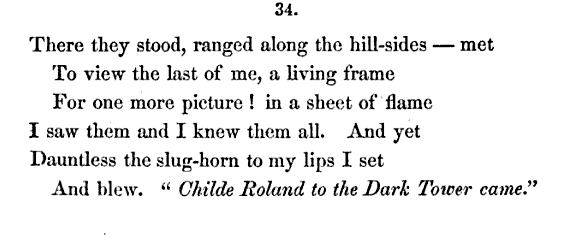


-- as Roland achieves the italicized otherness, timelessness, of the original. Italics were invented by Aldus in the fifteenth century (and supposed to imitate Petrarch's handwriting, so a great authority's annotation or addition to a printed text.  They stand, originally, for something that comes from elsewhere, something that doesn't belong to the original, to the utterer of the text we are reading, but to which that text is sufficiently relevant that it is entitled to demand or to entreat the italicized words. They are words granted or permitted from elsewhere. The italicized words in the King James Bible are the translators' clarifying additions, permitted, but only under that flag, by the sublime austerity of the original, its sublimity reflected in the italics that the supplementary words must display; the italicized words in quotations (italics were far older signs of quotation than are our inverted commas) were the words of another that for a moment the text wishes to display while not presuming to take possession of them. We put titles in italics to show that their title belongs to some other, that we are not the originators of the phrase. Italics and quotation marks have a similar genealogy and have leap-frogged each other in their somewhat out-of-synch history, but the point is whatever quotation marks have ever done, so have italics, and vice versa.

At the end of " ' Childe Roland to the Dark Tower Came. ' " the quotation marks are for Roland himself: here are the words I uttered. But he didn't quite utter them: he blew them (in proper Shelleyean manner) through the slug-horn, both horn and slogan (the origin of the word), so that what he blew became the self that was that quotation. And if the quotation marks are his, the sign of his breath through the horn, his utterance of words come from elsewhere, through the trumpeting of the prophecy that the words constitute, the italics denote Shakespeare, or Edgar, or Lear (the play), or the source that makes Edgar's song a quotation of a line from elsewhere. That last most of all: Shakespeare quotes them from elsewhere, and now Browing is quoting them from that same elsewhere.

What does this have to do with shortish accounts of the rhyme? Only this: that we feel the rhyme must rhyme (that's why it's from a "song"); and Browning makes it rhyme (with "flame" and "frame"), and yet the line still stands alone, rhyming with some word in a context orthogonal to the poem and to the song, a kind of signal from that other world of the rhyme we'll never know, but a rhyme that we know the line we do have nails, know it simply through the fact that Childe Roland to the Dark Tower came.

Tuesday, June 14, 2011

Poetry and the contagion of affect

Balaustion (Browning's Balaustion) prefaces her by-heart recital of Euripides' Hecuba with these words, which can form a kind of motto for the practice of rapturous quotation:
                                 no one of all the words
O' the play but is grown part now of my soul,
Since the adventure. 'T is the poet speaks:
But if I, too, should try and speak at times,
Leading your love to where my love, perchance,
Climbed earlier, found a nest before you knew —
Why, bear with the poor climber, for love's sake!
I think Browning is remembering -- and so he, too, is speaking -- the words that end Shelley's "When the Lamp is Shattered":

When hearts have once mingled,
Love first leaves the well-built nest;
The weak one is singled
To endure what it once possessed.
O Love! who bewailest
The frailty of all things here,
Why choose you the frailest
For your cradle, your home, and your bier?

Its passions will rock thee,
As the storms rock the ravens on high;
Bright reason will mock thee,
Like the sun from a wintry sky.
From thy nest every rafter
Will rot, and thine eagle home
Leave thee naked to laughter,
When leaves fall and cold winds come.
These lines have occasioned much unnecessary confusion.  What Shelley meant, and what Browning saw, was that the personification of Love ("thee") opens it to the experience of all human beings: abandonment by love.  Love itself experiences the loss of love.  (Personifications of love, from the Symposium onwards, will often have this strange effect; it may indeed be in view of this effect that love is so often personified, standing on the burning deck reciting "Casabianca", hiding his face among a crowd of stars.) Balaustion's beautiful inversion of this fate leads us back to love's nest: her love for Euripides encouraging our own.

It may be too that in remembering Shelley Browning is remembering Dante, and the strange affection between shades that Statius and Virgil feel for each other.  In Purgatory the saved Statius tries to embrace the unsaved Virgil's feet, but Virgil reminds him that they are shades that that they are seeing shades.  Statius replies that his love for Virgil was so great that he forgot this unforgettable fact: that they are dead.

Virgil returns the compliment at the beginning of the next Canto (Purgatorio 22):
                                          "Amore
acceso di virtù, sempre altro accese,
pur che la fiamma sua paresse fore;

onde da l’ora che tra noi discese
nel limbo de lo ’nferno Giovenale,
che la tua affezion mi fé palese,

mia benvoglienza inverso te fu quale
più strinse mai di non vista persona,
sì ch’or mi parran corte queste scale.

-----

                                              Love,
Ignited by some power, spreads its flame
to others, if its fire flares above

The surface, vividly. When, Hellwards, came
Juvenal to Limbo, joined us there, and
made me know your love, I felt your claim

On my benevolence, by far more fair
Than any had yet felt for unseen persons,
so now it seems with ease I climb this stair.
Virgil loves Statius because Statius loves Virgil's poetry, loves it right, loves it deeply, loves it as should be loved: loves a shade.  There is nothing remotely self-absorbed about Virgil's love for Statius. Rather the poetry he wrote is, like all poems, an invitation to loving something together: something, to put it in the most banal and yet the deepest terms, quotable.

And indeed that's what Statius is about to to do: he quotes from the Aeneid to explain his own salvation.  Virgil's bitter critique of the corruption that gold produces among all humans wakens Statius to clearer thinking about avarice and prodigality, and he narrowly escapes hell, thanks to his master, who does not.  The words have a life of their own, like Love.