I've been thinking (and hope to do a series of posts about) what we're doing when we think actively. I don't mean how does a thought develop according to its internal logic or potentialities. I mean to try to think about some consequences of the fact that what makes thinking thinking (what makes it discursive and not intuitive) is that it's hard. Its difficulty has something to do with its content, with where it arrives, with what it learns. (I am not much alluding here to the distinction that Daniel Kahneman makes in his great book Thinking Fast and Slow, though it's not irrelevant. More relevant still might be George Ainslie's Breakdown of Will, but I'm not going to say much explicitly about either, except to note that both are interested in the Housmanian fact that thought is irksome, and three minutes a long time.)
By the relation of difficulty to content, I don't mean less that some content is hard than that hardness is something that thinking thinks about. Difficulty of thought leads to thinking about difficulty and what difficulty means about the thinking you're doing. This feedback loop (we avoid the word "dialectic" in this blog: too easy a landing place)-- this feedback loop obviously has something to do with poetic thinking, which is what I want to get to in a later post.
Here I just want to try to note what I mean by making an observation about the rhetoric of rhetorical questions. Why are there such things? Why are the rhetorically effective? There are obvious answers having to do with some aspects of irony and quotation, of ironic quotation, so to speak. "Shall the blessed sun of heaven prove a milcher and eat blackberries? A question not to be asked." (1 Henry IV)
So it's only asked in retroactive quotation marks that the question makes its appearance. Who would ask such a question? The targets of our irony, of the irony nous autres share with respect to the person who doesn't realize that it's irony.
But what I'm interested in is the role that a rhetorical question plays in genuine discursive thinking. It raises a real issue or some consequence of a real issue that has to be thought through (even in the most demagogic situations: without real issues there's no occasion for rhetoric of any sort). And it asks for help in thinking it through. A rhetorical question assumes a listener, and that listener is a sort of check or hedge for thought. To ask a question is to see that thinking is partly social, that the fact that it occurs discursively, in language, is important. Thinking is about judging, and proper judging is or should be always a vicarious, because a disinterested, activity.
When we ask a question with a foreordained answer, it matters that we get the foreordained answer. That ratifies our judgment, vicariously as I say. It ratifies the fact that it is a judgment, that we can ask others and expect them to concur. The retroactive feature of rhetorical questions that I've just noted is a sort of check-bit when the thought is done, making sure that the judgment now seems unassailable, no?
I don't mean that rhetorical questions always constitute genuine thought. But I expect they do whenever they're first formulated. At any rate, they stand for the larger class of ways of guiding thought. "The experience of being guided" (Wittgenstein) is what thought thinks about (it had better), whatever else it thinks about, whenever it thinks. (This is one clear commonality between the Tractatus and Philosophical Investigations.)
This has everything to do with what it means to be a writer, in the Blanchotian sense that I so revere.
Wednesday, May 9, 2012


Thursday, April 12, 2012
Two types of metafiction
One might think: if philosophy speaks of the use of the word "philosophy" there must be a second-order philosophy. But it is not so: it is, rather, like the case of orthography, which deals with the word "orthography" among others without then being second-order.
--Wittgenstein
I've been thinking about two types of metafiction, or at least metafictional moments: the type we're all too familiar with in recent years, where the metafiction is the point, and the (what to call it?) target fiction is in its service, and another more common, more exhilarating type (as I have come to think), where metafictional moments are actually in service of the story itself.
The first type - let Susanna Moore or Charlie Kaufman, or Borges, or Philip Roth or K. Dick stand for its practitioners - keeps you checking on its coherence. Does the level of self-reflexivity interact coherently with the other level, that which it self-reflexively circles or twists back into and out of? I guess all the paradoxes of time-travel SF form a subset of this kind of metafiction. It's a game, and the game is to see how the first-level fiction can unfold with at least some of its characters, and some putative or plausible audience members, unaware of its metafictional, metaphysical determinants. The fun is to get it, to see how well or how cleverly it works. And that is fun, but only one kind of fun. Of course in Roth or Nabokov or Dick, there are other kinds of fun as well. But somehow the metafictional perfection of their metafictional narratives subordinates all other aspects of those narratives to the self-reflexive theme.
The result is a kind of defensive irony, or at least the knowingness of an endlessly self-aware irony to which all events, characters, hopes, recognitions, resolutions reduce. Nothing really matters as its own moment: it's all the fulfillment of the typological structure of metafiction. The tone wears thin after a few decades of this.
The other kind of metafiction is exuberantly undefensive. Cervantes or Shakespeare "Nay, then, God be wi' you, an you talk in blank verse") are two obvious examples, but we could add Austen (especially Northanger Abbey), Melville, Thackeray, Marías, Bolaño and the more recent work of Steve Erickson (right now I am thinking in particular of These Dreams of You) to the list. There the metafiction is just a quick, convenient, fun, and pre-eminently local part of the fiction. The fiction isn't dragooned into serving the metafictional demonstration; the metafiction forms part of the series of events or incidents that the fiction delights in displaying.
So I guess this is really a post about fictional delight. It takes a long time to learn or relearn to read, and probably to write, fiction which knows about all the ways that it can be made to thematize itself, without being much concerned to show its mastery of such things. It's got other fish to fry - it's got fish to fry, is the point, and metafiction is one fish among others, tasty enough in convenient quantities in a varied diet, but not (as Blake said Swedenborg believed of himself) "the single one on earth that ever broke a net."
Tuesday, March 20, 2012
Rhyme and meter, part 4b: Childe Roland
The second in a series of fairly frequent, short(ish) followups to Part 4 in this series.
"Childe Roland to the dark tower came"comes from Edgar's song in Lear, and then is to be found again in Browning's poem titled " 'Childe Roland to the Dark Tower Came.' " Note that the quotation marks and the sentence-ending period are part of the title --
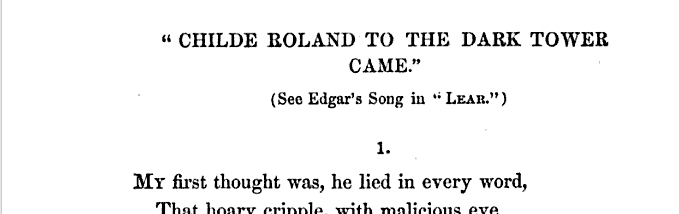
-- and that this is confirmed by the running heads in the original:

Browning's title is a quotation of Shakespeare's line, and the fact that it's a quotation matters. In Shakespeare the line doesn't rhyme; and yet it feels like a line that must rhyme in the song of which it's a fragment. At least it feels that way to Browning, whose attributional parenthesis under the title is: "(See Edgar's song in Lear.)", also with a period at the end (I could be convinced that case matters to, but I don't think that here there's any harm in the mild difference between our titling conventions and Browning's):

Then, at the end of Browning's poem - it's not the song Edgar is singing; rather Edgar must be singing a song based on Roland's adventure, which, Bloomianly, transumes the song - at the end of Browning's poem, we get the line in both quotation marks and italics --
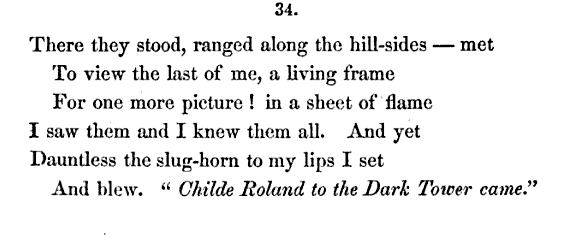
-- as Roland achieves the italicized otherness, timelessness, of the original. Italics were invented by Aldus in the fifteenth century (and supposed to imitate Petrarch's handwriting, so a great authority's annotation or addition to a printed text. They stand, originally, for something that comes from elsewhere, something that doesn't belong to the original, to the utterer of the text we are reading, but to which that text is sufficiently relevant that it is entitled to demand or to entreat the italicized words. They are words granted or permitted from elsewhere. The italicized words in the King James Bible are the translators' clarifying additions, permitted, but only under that flag, by the sublime austerity of the original, its sublimity reflected in the italics that the supplementary words must display; the italicized words in quotations (italics were far older signs of quotation than are our inverted commas) were the words of another that for a moment the text wishes to display while not presuming to take possession of them. We put titles in italics to show that their title belongs to some other, that we are not the originators of the phrase. Italics and quotation marks have a similar genealogy and have leap-frogged each other in their somewhat out-of-synch history, but the point is whatever quotation marks have ever done, so have italics, and vice versa.
At the end of " ' Childe Roland to the Dark Tower Came. ' " the quotation marks are for Roland himself: here are the words I uttered. But he didn't quite utter them: he blew them (in proper Shelleyean manner) through the slug-horn, both horn and slogan (the origin of the word), so that what he blew became the self that was that quotation. And if the quotation marks are his, the sign of his breath through the horn, his utterance of words come from elsewhere, through the trumpeting of the prophecy that the words constitute, the italics denote Shakespeare, or Edgar, or Lear (the play), or the source that makes Edgar's song a quotation of a line from elsewhere. That last most of all: Shakespeare quotes them from elsewhere, and now Browing is quoting them from that same elsewhere.
What does this have to do with shortish accounts of the rhyme? Only this: that we feel the rhyme must rhyme (that's why it's from a "song"); and Browning makes it rhyme (with "flame" and "frame"), and yet the line still stands alone, rhyming with some word in a context orthogonal to the poem and to the song, a kind of signal from that other world of the rhyme we'll never know, but a rhyme that we know the line we do have nails, know it simply through the fact that Childe Roland to the Dark Tower came.
"Childe Roland to the dark tower came"comes from Edgar's song in Lear, and then is to be found again in Browning's poem titled " 'Childe Roland to the Dark Tower Came.' " Note that the quotation marks and the sentence-ending period are part of the title --
-- and that this is confirmed by the running heads in the original:
Browning's title is a quotation of Shakespeare's line, and the fact that it's a quotation matters. In Shakespeare the line doesn't rhyme; and yet it feels like a line that must rhyme in the song of which it's a fragment. At least it feels that way to Browning, whose attributional parenthesis under the title is: "(See Edgar's song in Lear.)", also with a period at the end (I could be convinced that case matters to, but I don't think that here there's any harm in the mild difference between our titling conventions and Browning's):
Then, at the end of Browning's poem - it's not the song Edgar is singing; rather Edgar must be singing a song based on Roland's adventure, which, Bloomianly, transumes the song - at the end of Browning's poem, we get the line in both quotation marks and italics --
-- as Roland achieves the italicized otherness, timelessness, of the original. Italics were invented by Aldus in the fifteenth century (and supposed to imitate Petrarch's handwriting, so a great authority's annotation or addition to a printed text. They stand, originally, for something that comes from elsewhere, something that doesn't belong to the original, to the utterer of the text we are reading, but to which that text is sufficiently relevant that it is entitled to demand or to entreat the italicized words. They are words granted or permitted from elsewhere. The italicized words in the King James Bible are the translators' clarifying additions, permitted, but only under that flag, by the sublime austerity of the original, its sublimity reflected in the italics that the supplementary words must display; the italicized words in quotations (italics were far older signs of quotation than are our inverted commas) were the words of another that for a moment the text wishes to display while not presuming to take possession of them. We put titles in italics to show that their title belongs to some other, that we are not the originators of the phrase. Italics and quotation marks have a similar genealogy and have leap-frogged each other in their somewhat out-of-synch history, but the point is whatever quotation marks have ever done, so have italics, and vice versa.
At the end of " ' Childe Roland to the Dark Tower Came. ' " the quotation marks are for Roland himself: here are the words I uttered. But he didn't quite utter them: he blew them (in proper Shelleyean manner) through the slug-horn, both horn and slogan (the origin of the word), so that what he blew became the self that was that quotation. And if the quotation marks are his, the sign of his breath through the horn, his utterance of words come from elsewhere, through the trumpeting of the prophecy that the words constitute, the italics denote Shakespeare, or Edgar, or Lear (the play), or the source that makes Edgar's song a quotation of a line from elsewhere. That last most of all: Shakespeare quotes them from elsewhere, and now Browing is quoting them from that same elsewhere.
What does this have to do with shortish accounts of the rhyme? Only this: that we feel the rhyme must rhyme (that's why it's from a "song"); and Browning makes it rhyme (with "flame" and "frame"), and yet the line still stands alone, rhyming with some word in a context orthogonal to the poem and to the song, a kind of signal from that other world of the rhyme we'll never know, but a rhyme that we know the line we do have nails, know it simply through the fact that Childe Roland to the Dark Tower came.
Saturday, March 17, 2012
Rhyme and meter, part 4a: "But still a ruby kindles in the vine."
The examples in my previous post may have been a little too anomalous, but they were partly designed to show that generally we don't even think about whether a line rhymes or not. We sort of know it. What makes things interesting, and what those examples were meant to bring out a little bit more than usually, is what it means to "sort of" know that a line rhymes. Or rather how much "sort of rhyming" just means the same thing as rhyming, and how much it doesn't.
What I am after is the experience we might have when we try to reconstruct a half-remembered poem. We might go wrong by trying to find a rhyme for an unrhymed line, or we might fail to remember that a particular line did rhyme. Form will help, of course: in a Spenserian stanza, all the lines rhyme; in a quatrain the odd lines could easily fail to. But sometimes the line itself will bring with it its own obscure metadata: this line rhymes; this line doesn't. How is that metadata compressed into, distributed over, the line itself? I've been giving examples where I think the "metadata" are more interesting, more ambiguous, than usual.
Take the line that I played with: "But still a ruby kindles in the vine." I suggested three prosodical contexts for it: in a blank verse quatrain, a quatrain rhymed xaxa, and one rhymed abab. I should have offered a fourth, and will do so here. The third of the four improvisations below is new:
The bolded stanza differs from the second by rhyming "vine," just as the last one does; but differs also in that it's the only one in which the line we're concerned about concludes the stanza. It's hard, as I say, not to feel that the attention we're paying to the line now alters how we feel about it, makes it difficult to say really how much attention we would have paid in the normal course of reading. But maybe the original context will be novel enough, after all of this, that you can read it with fresh eyes while noting, on the fly, the line's effect:
So they contribute to rhyme, and the way they do so is metrical and rhythmical. And the concept that we might derive from them is this: the adjacency of the experience of true rhyme to that of the metrical setting up of, the metrical structuring of, the line that rhymes. This structuring can occur within a line (pretty obviously: the Indoeuropean rule for meter is: loose onsets, strict endings, and they are all the stricter for rhyming), but it can also occur from one line to the next, from an unrhymed line introducing a rhymed one, or even a rhymed line introducing another, either through alternation or even as a couplet. (I think Dryden's triplets often work the same way: the gentle shock of mild surprise at the unexpected continuation of a rhyme says something similar about how rhyme may be structured by elements outside the line it appears in.)
This structuring is what makes us feel (if we do) the unrhymed rhymes in Carrol's "Mad Gardener's Song," which I cited before:
What I am after is the experience we might have when we try to reconstruct a half-remembered poem. We might go wrong by trying to find a rhyme for an unrhymed line, or we might fail to remember that a particular line did rhyme. Form will help, of course: in a Spenserian stanza, all the lines rhyme; in a quatrain the odd lines could easily fail to. But sometimes the line itself will bring with it its own obscure metadata: this line rhymes; this line doesn't. How is that metadata compressed into, distributed over, the line itself? I've been giving examples where I think the "metadata" are more interesting, more ambiguous, than usual.
Take the line that I played with: "But still a ruby kindles in the vine." I suggested three prosodical contexts for it: in a blank verse quatrain, a quatrain rhymed xaxa, and one rhymed abab. I should have offered a fourth, and will do so here. The third of the four improvisations below is new:
But still a ruby kindles in the vine;
A glistering diamond shineth in the dew.
The morning's freshness fills me with delight.
The promised evening soothes me with its rest.
or
But still a ruby kindles in the vine;
A glistering diamond shineth in the dew.
The morning's freshness fills me with delight.
Its early, ancient jewels are ever new.
or
When with the sun depart the jewels of day
The jewels of night, though dark, are just as fine:
No glistering diamond shineth in the dew
But still a ruby kindles in the vine.
or
But still a ruby kindles in the vine;
A glistering diamond shineth in the dew.
These star-flared jewels are gathered from no mine
But fall like sunlight, ever fresh and new.
The bolded stanza differs from the second by rhyming "vine," just as the last one does; but differs also in that it's the only one in which the line we're concerned about concludes the stanza. It's hard, as I say, not to feel that the attention we're paying to the line now alters how we feel about it, makes it difficult to say really how much attention we would have paid in the normal course of reading. But maybe the original context will be novel enough, after all of this, that you can read it with fresh eyes while noting, on the fly, the line's effect:
Iram indeed is gone with all his Rose,A Rubaiyat stanza, because it's one of Fitzgerald's Rubaiyat. Note that it's the only line that doesn't rhyme. Rubaiyat rhyme aaxa, and this is the x-line. But generally we don't notice the x lines as different in rubaiyat: really, they seem a breath taken before the last, decisively rhyming line, and make that last rhyme feel all the more decisive.
And Jamshyd's Sev'n-ring'd Cup where no one knows;
But still a Ruby kindles in the Vine,
And many a Garden by the Water blows.
So they contribute to rhyme, and the way they do so is metrical and rhythmical. And the concept that we might derive from them is this: the adjacency of the experience of true rhyme to that of the metrical setting up of, the metrical structuring of, the line that rhymes. This structuring can occur within a line (pretty obviously: the Indoeuropean rule for meter is: loose onsets, strict endings, and they are all the stricter for rhyming), but it can also occur from one line to the next, from an unrhymed line introducing a rhymed one, or even a rhymed line introducing another, either through alternation or even as a couplet. (I think Dryden's triplets often work the same way: the gentle shock of mild surprise at the unexpected continuation of a rhyme says something similar about how rhyme may be structured by elements outside the line it appears in.)
This structuring is what makes us feel (if we do) the unrhymed rhymes in Carrol's "Mad Gardener's Song," which I cited before:
He thought he saw an ElephantElephant, Buffalo, Rattlesnake don't rhyme. Their initial caps give them a certain solid dignity, though, and entitle them to be heard as cretics rather than dactyls, and indeed cretics verging on anapests: elePHANT, buffaLO, rattleSNAKE. They don't rhyme but the strongly suggest rhyme, if not their own than at least of the poem they belong to. And it seems that experientially the suggestion of rhyme and rhyme itself tend to merge.
That practised on a fife:
He looked again, and found it was
A letter from his wife.
"At length I realize," he said,
"The bitterness of life!"
He thought he saw a Buffalo
Upon the chimney-piece:
He looked again, and found it was
His Sister's Husband's Niece.
"Unless you leave this house," he said,
"I'll send for the police!"
he thought he saw a Rattlesnake
That questioned him in Greek:
He looked again, and found it was
The Middle of Next Week.
"The one thing I regret," he said,
"Is that it cannot speak!"
Thursday, March 15, 2012
Rhyme and meter, part 4: Does that rhyme?
Can you tell when a line rhymes? I don't mean can you tell when two lines rhyme: that's usually pretty. But consider this list of lines, drawn from different poems. Don't look them up. Just contemplate them for a while - and, if you can, remember, where they come from, or if you can, forget.
There are a few of questions that can be asked about each one.
First of all, does it rhyme? I think in most cases, even if you don't know the poem, you'd have a pretty good guess. If so, what I'd like to ask is how you know, or seem to know. (I think I'll try posting a sort of phenomenological description of each line, as well as the answer to the question, in a few short subsequent posts.)
Focusing on this question can give rise to further observations. Would it matter if you knew the position of the line in the poem, or at least in a stanza? Just for simplicity, let's distinguish between opening line, medial line, and closing line. Can you tell which of these are last lines?
If you can tell where in a stanza each line goes, is it a sense that they rhyme, or don't rhyme, that determines where you place the line? I ask it this way to be provocative, but also to try to get you to use fresh eyes, fresh ears. The converse question is probably more obvious, so consider that too: would the placement of the line affect your sense of whether it rhymed?
Let's take the last line as an example: "But still a ruby kindles in the vine." If you knew that it was the first line of a stanza, would you expect it to be an onset rhyme or not? (Onset rhyme: the word we have in mind that a later word will resolve by rhyming with it.) Let's be simplistic. Which is most likely:
It probably matters what order you read them in: form and rhyme prime us for more of that form, and if there's rhyme, for more rhyme. But try to think of them independently, or of the line independently. At the start of a stanza, will it rhyme?
How about in the midst of one? At the end of one?
So try these exercises with all the lines quoted above:
First say of each line whether you think it's opening, medial, or closing.
Then try to say of each line whether it rhymes, and decide whether its place in the stanza makes a difference to whether you think it rhymes. What kind of work, or what kind of attention, do you have to do to make it seem rhymed? To make it seem unrhymed?
My simplified guess is that you'll be able to tell the rhymed lines just by their form in most of the cases here. And I guess as well that the deceptions will be systematic: that some of the lines here will strike a large majority as rhyming when they don't, or as not rhyming when they do. The ones that are deceptive in this way are all the more interesting for that.
To be continued....
"Childe Roland to the dark tower came"It's probably hard to stay in the right frame of mind to really be able to think about each line, but just try.
"Lay hidden in the small-slate colored thing"
"And thee, returning on thy silver wheels"
"And wash the dusk with silver. Soon, full soon"
"And if thou wilt, remember"
"Or just some human sleep"
"The everlasting universe of things"
"Welcome, proud lady"
"They had changed their throats and had the throats of birds"
"The dying of the golden and the grey"
"Each care decays, and yet my sorrow springs"
"But still a ruby kindles in the vine"
There are a few of questions that can be asked about each one.
First of all, does it rhyme? I think in most cases, even if you don't know the poem, you'd have a pretty good guess. If so, what I'd like to ask is how you know, or seem to know. (I think I'll try posting a sort of phenomenological description of each line, as well as the answer to the question, in a few short subsequent posts.)
Focusing on this question can give rise to further observations. Would it matter if you knew the position of the line in the poem, or at least in a stanza? Just for simplicity, let's distinguish between opening line, medial line, and closing line. Can you tell which of these are last lines?
If you can tell where in a stanza each line goes, is it a sense that they rhyme, or don't rhyme, that determines where you place the line? I ask it this way to be provocative, but also to try to get you to use fresh eyes, fresh ears. The converse question is probably more obvious, so consider that too: would the placement of the line affect your sense of whether it rhymed?
Let's take the last line as an example: "But still a ruby kindles in the vine." If you knew that it was the first line of a stanza, would you expect it to be an onset rhyme or not? (Onset rhyme: the word we have in mind that a later word will resolve by rhyming with it.) Let's be simplistic. Which is most likely:
But still a ruby kindles in the vine;
A glistering diamond shineth in the dew.
The morning's freshness fills me with delight.
The promised evening soothes me with its rest.
or
But still a ruby kindles in the vine;
A glistering diamond shineth in the dew.
The morning's freshness fills me with delight.
Its early, ancient jewels are ever new.
or
But still a ruby kindles in the vine;
A glistering diamond shineth in the dew.
These star-flared jewels are gathered from no mine
But fall like sunlight, ever fresh and new.
It probably matters what order you read them in: form and rhyme prime us for more of that form, and if there's rhyme, for more rhyme. But try to think of them independently, or of the line independently. At the start of a stanza, will it rhyme?
How about in the midst of one? At the end of one?
So try these exercises with all the lines quoted above:
First say of each line whether you think it's opening, medial, or closing.
Then try to say of each line whether it rhymes, and decide whether its place in the stanza makes a difference to whether you think it rhymes. What kind of work, or what kind of attention, do you have to do to make it seem rhymed? To make it seem unrhymed?
My simplified guess is that you'll be able to tell the rhymed lines just by their form in most of the cases here. And I guess as well that the deceptions will be systematic: that some of the lines here will strike a large majority as rhyming when they don't, or as not rhyming when they do. The ones that are deceptive in this way are all the more interesting for that.
To be continued....
Sunday, March 4, 2012
Rhyme and meter, part 3: What we can hear, and what they could
I'll want to return to my previous set of examples in a future post; here I want to start by considering one more. A naive historian of rhyme might think that what doesn't sound like a rhyme to us ("hand or eye / symmetry") would have been more natural in a different dialect or pronunciation. True we can hear eye as diphthongized (as the unlovely linguistic term has it): the slow-motion pronunciation would decompress it to "ah-ee" (the way Mark Twain or Kate Chopin might write it). That tweak would turn this into a natural rhyme, which sounds forced only to those who pronounce as we do, here, now.
So wind/mind is okay, but you'll never find (I do not think) weened/mind, though that would seem a closer parallel to eye/symmetry or (say) we/my.
So here's the passage I want to think about, from Sidney, the octet of Atrophel and Stella 86:
Note that the rhyme scheme is obvious here abbaabba. But this isn't inevitable: some of the sonnets rhyme (in their octets) abababab, and if eye can rhyme with me, it would seem that some could argue that the latter rhyme scheme governs here as well. We're facing here an example of the sort of thing that Wittgenstein ponders when he considers the problem of rule-following: there is a rule that can justify any sequence. (My favorite recent example is the sequence that begins sweetly enough as 0, 1, 2, but whose fourth member (scroll down if this isn't of tremendous interest to you) is
a number with 1,747 digits. But there's a rule for that.* Wittgenstein wants to know what makes a rule the right rule to follow, when there's no rule that could make it the right rule to follow that couldn't itself be followed in an infinite number of different ways. His answer, more or less, is practice ratified by the relationship of learning and teaching the belongs to "agreement in forms of life." Hannah Ginsborg, more or less in agreement with Stanley Cavell, calls such agreement in forms of life "primitive normativity."
Anyhow, back to our example. Sidney likes partially ambiguous forms. The famous "night and day" sonnet has only two rhyme words:
Note that we're already chunking by taking homoteleuton (or repetition of endings) as rhyme. "Night" doesn't rhyme with "night," not even richly. It repeats the word (as in a sestina, the form Sidney introduced into English). You might almost call it a duina, at least the part that cycles night day day night night day day night. (On the relation of n-inas to prime numbers, see this short paper which proves that if an n-ina cycles, 2n+1 is prime: 5 in the case of a duina, where n=2. The converse doesn't hold, though.) In Dante, except for the repeated endings on "Christ" - which must not be adulterated by the arbitrary similarity of rhyming words - repetition is always rime riche: this is a principle of interpretation, so that you can understand an ambiguous word (such as torna, palma, and pianta, all rhymed with homonyms in Paradiso IX) as requiring difference in meaning between its orthographically identical homonyms, which can help solve the ambiguity.
The point is that in reading rhymed poetry we assess similarity pretty subtly, and assess as well the difference that prevents similarity from just being identity. Rhymes have a lot of give, but (as with stress) how much give they have is always contextualized by the rhyme scheme that determines them, and by the rhymes that surround them. Night and day rhyme with themselves because they belong to a sonnet with a familiar rhyme scheme; piante and piante rhyme because they belong to a rhyme schemes that eschews self-rhyming, so that they therefore don't mean the same thing.
And this allows us to return to sonnet 86, where we can have no doubt that the rhyme scheme is abbaabba. Why no doubt? Why not abababab? Because the prosodical context and the closeness of sound brings out, here, the difference between I and be, me and eye. Sidney takes pains to prevent our being misled by the conventional rhyming of, say, me and eye, by making sure that the first, the a, rhyme-pair is homophonic: I/eye. We then have to work to separate them via their different meanings, and that very work of separation (as in Dante) pairs them: very similar but still different.
Sidney's fearless symmetry makes sure we keep track of what's rhyming with what, even when doing so requires some involved and subtle distinction.
And here's the payoff of the always pain-in-the-ass subtlety of following a formal analysis. Making us keep track of the rhymes, especially in a fairly monochromatic context, is a way of infiltrating our sense of rhyme with a sense of meaning and vice versa. These are considerations that we're used to understanding when it comes to poetic meter, where the interaction of metrical and semantic stress contributes to our understanding of what's being said. It's interesting that there's a subtle analogue of this in rhyme as well, which suggests that the interaction, both prosodically and semantically, between rhyme and meter is closer than has usually been suspected.
-----
*viz., 0 followed by 0 bangs = 0; 1 followed by 1 bang (1! or 1 factorial) = 1; 2!! (2 factorial factorial, 2 followed by 2 bangs = 2; 3!!! (3 factorial factorial factorial) = 720! = the foregoing.
But it's harder to say the same of the near parallel, and very frequent rhymes on internal "i" sounds. Shakespeare and Donne, to quote the two most obvious examples, rhyme such words as wind and mind. (The doggerel rhyme to Rosalind in As You Like It in my first example has taught generations of actors how to pronounce her name: majority rhyme seems to win, though I think it would be interesting to go with the early returns that turn out to be the minority: Ind and wind.)
From the east to western Ind,
No jewel is like Rosalind.
Her worth, being mounted on the wind,
Through all the world bears Rosalind.
All the pictures fairest lined
Are but black to Rosalind.
Let no fair be kept in mind
But the fair of Rosalind.
* * *
If a hart do lack a hind,
Let him seek out Rosalind.
If the cat will after kind,
So be sure will Rosalind.
Winter garments must be lined,
So must slender Rosalind.
They that reap must sheaf and bind;
Then to cart with Rosalind.
Sweetest nut hath sourest rind,
Such a nut is Rosalind.
He that sweetest rose will find
Must find love's prick and Rosalind.
-----------------Remember that Wyatt, too, knows where is an hind, though in a net he seeks to catch the wind. Nor let us forget Arlo Guthrie's great motorcycle song, which has him, as needed, rhyming pickle with motor-sickle, and die with motor-sigh- / (cul), as his folk rock pronunciation allows.
Go and catch a falling star,
Get with child a mandrake root,
Tell me where all past years are,
Or who cleft the devil's foot,
Teach me to hear mermaids singing,
Or to keep off envy's stinging,
And find
What wind
Serves to advance an honest mind.
So wind/mind is okay, but you'll never find (I do not think) weened/mind, though that would seem a closer parallel to eye/symmetry or (say) we/my.
So here's the passage I want to think about, from Sidney, the octet of Atrophel and Stella 86:
Alas, whence came this change of lookes? if I
Haue chang'd desert, let mine owne conscience be
A still felt plague, to selfe condemning me:
Let wo gripe on my heart, shame loade mine eye,
But if all faith, like spotlesse Ermine ly
Safe in my soule, which onely doth to thee
(As his sole object of felicitie)
With wings of Loue in aire of wonder flie....
Note that the rhyme scheme is obvious here abbaabba. But this isn't inevitable: some of the sonnets rhyme (in their octets) abababab, and if eye can rhyme with me, it would seem that some could argue that the latter rhyme scheme governs here as well. We're facing here an example of the sort of thing that Wittgenstein ponders when he considers the problem of rule-following: there is a rule that can justify any sequence. (My favorite recent example is the sequence that begins sweetly enough as 0, 1, 2, but whose fourth member (scroll down if this isn't of tremendous interest to you) is
260,121,894,356,579,510,020,490,322,708,104,361,119,152,187,501,694,578,572,754,183,785,083,563,115,694,738,224,067,857,795,813,045,708,261,992,057,589,224,725,953,664,156,516,205,201,587,379,198,458,774,083,252,910,524,469,038,881,188,412,376,434,119,195,104,550,534,665,861,624,327,194,019,711,390,984,553,672,727,853,709,934,562,985,558,671,936,977,407,000,370,043,078,375,899,742,067,678,401,696,720,784,280,629,229,032,107,161,669,867,260,548,988,445,514,257,193,985,499,448,939,594,496,064,045,132,362,140,265,986,193,073,249,369,770,477,606,067,680,670,176,491,669,403,034,819,961,881,455,625,195,592,566,918,830,825,514,942,947,596,537,274,845,624,628,824,234,526,597,789,737,740,896,466,553,992,435,928,786,212,515,967,483,220,976,029,505,696,699,927,284,670,563,747,137,533,019,248,313,587,076,125,412,683,415,860,129,447,566,011,455,420,749,589,952,563,543,068,288,634,631,084,965,650,682,771,552,996,256,790,845,235,702,552,186,222,358,130,016,700,834,523,443,236,821,935,793,184,701,956,510,729,781,804,354,173,890,560,727,428,048,583,995,919,729,021,726,612,291,298,420,516,067,579,036,232,337,699,453,964,191,475,175,567,557,695,392,233,803,056,825,308,599,977,441,675,784,352,815,913,461,340,394,604,901,269,542,028,838,347,101,363,733,824,484,506,660,093,348,484,440,711,931,292,537,694,657,354,337,375,724,772,230,181,534,032,647,177,531,984,537,341,478,674,327,048,457,983,786,618,703,257,405,938,924,215,709,695,994,630,557,521,063,203,263,493,209,220,738,320,923,356,309,923,267,504,401,701,760,572,026,010,829,288,042,335,606,643,089,888,710,297,380,797,578,013,056,049,576,342,838,683,057,190,662,205,291,174,822,510,536,697,756,603,029,574,043,387,983,471,518,552,602,805,333,866,357,139,101,046,336,419,769,097,397,432,285,994,219,837,046,979,109,956,303,389,604,675,889,865,795,711,176,566,670,039,156,748,153,115,943,980,043,625,399,399,731,203,066,490,601,325,311,304,719,028,898,491,856,203,766,669,164,468,791,125,249,193,754,425,845,895,000,311,561,682,974,304,641,142,538,074,897,281,723,375,955,380,661,719,801,404,677,935,614,793,635,266,265,683,339,509,760,000,000,000,000,000,000,000,000,000,000,000,000,000,000,000,000,000,000,000,000,000,000,000,000,000,000,000,000,000,000,000,000,000,000,000,000,000,000,000,000,000,000,000,000,000,000,000,000,000,000,000,000,000,000,000,000,000,000,000 --
a number with 1,747 digits. But there's a rule for that.* Wittgenstein wants to know what makes a rule the right rule to follow, when there's no rule that could make it the right rule to follow that couldn't itself be followed in an infinite number of different ways. His answer, more or less, is practice ratified by the relationship of learning and teaching the belongs to "agreement in forms of life." Hannah Ginsborg, more or less in agreement with Stanley Cavell, calls such agreement in forms of life "primitive normativity."
Anyhow, back to our example. Sidney likes partially ambiguous forms. The famous "night and day" sonnet has only two rhyme words:
Now that of absence the most irksome night,Two rhyme words, but what's the rhyme scheme? I think it's too easy to stay with just a and b: most sonnets in Astrophel and Stella have four or five different rhyme pairs, typically rhymed abbaabbacdcdee, sometimes, e.g. the sonnet previous to this one, ababababccdeed, and again sometimes, as in the one before that, ababbabaccdccd. I think it would be better, and more natural, to "chunk" the night and day sonnet as rhymed abbaabbacdcdee: the rule of the sonnet form seems to require that.
With darkest shade doth ouercome my day;
Since Stellas eyes wont to giue me my day,
Leauing my Hemisphere, leaue me in night,
Each day seemes long, and longs for long-staid night,
The night as tedious, wooes th'approch of day;
Tired with the dustie toyles of busie day,
Languisht with horrors of the silent night;
Suffering the euils both of the day and night,
While no night is more darke then is my day,
Nor no day hath lesse quiet then my night:
With such bad mixture of my night and day,
That liuing thus in blackest winter night,
I feele the flames of hottest sommer day.
Note that we're already chunking by taking homoteleuton (or repetition of endings) as rhyme. "Night" doesn't rhyme with "night," not even richly. It repeats the word (as in a sestina, the form Sidney introduced into English). You might almost call it a duina, at least the part that cycles night day day night night day day night. (On the relation of n-inas to prime numbers, see this short paper which proves that if an n-ina cycles, 2n+1 is prime: 5 in the case of a duina, where n=2. The converse doesn't hold, though.) In Dante, except for the repeated endings on "Christ" - which must not be adulterated by the arbitrary similarity of rhyming words - repetition is always rime riche: this is a principle of interpretation, so that you can understand an ambiguous word (such as torna, palma, and pianta, all rhymed with homonyms in Paradiso IX) as requiring difference in meaning between its orthographically identical homonyms, which can help solve the ambiguity.
The point is that in reading rhymed poetry we assess similarity pretty subtly, and assess as well the difference that prevents similarity from just being identity. Rhymes have a lot of give, but (as with stress) how much give they have is always contextualized by the rhyme scheme that determines them, and by the rhymes that surround them. Night and day rhyme with themselves because they belong to a sonnet with a familiar rhyme scheme; piante and piante rhyme because they belong to a rhyme schemes that eschews self-rhyming, so that they therefore don't mean the same thing.
And this allows us to return to sonnet 86, where we can have no doubt that the rhyme scheme is abbaabba. Why no doubt? Why not abababab? Because the prosodical context and the closeness of sound brings out, here, the difference between I and be, me and eye. Sidney takes pains to prevent our being misled by the conventional rhyming of, say, me and eye, by making sure that the first, the a, rhyme-pair is homophonic: I/eye. We then have to work to separate them via their different meanings, and that very work of separation (as in Dante) pairs them: very similar but still different.
Sidney's fearless symmetry makes sure we keep track of what's rhyming with what, even when doing so requires some involved and subtle distinction.
And here's the payoff of the always pain-in-the-ass subtlety of following a formal analysis. Making us keep track of the rhymes, especially in a fairly monochromatic context, is a way of infiltrating our sense of rhyme with a sense of meaning and vice versa. These are considerations that we're used to understanding when it comes to poetic meter, where the interaction of metrical and semantic stress contributes to our understanding of what's being said. It's interesting that there's a subtle analogue of this in rhyme as well, which suggests that the interaction, both prosodically and semantically, between rhyme and meter is closer than has usually been suspected.
-----
*viz., 0 followed by 0 bangs = 0; 1 followed by 1 bang (1! or 1 factorial) = 1; 2!! (2 factorial factorial, 2 followed by 2 bangs = 2; 3!!! (3 factorial factorial factorial) = 720! = the foregoing.
Tuesday, February 7, 2012
Rhyme and meter, part 2: Non-regular rhyme
Try this little experiment. Read these passages of rhymed poetry:
Each of them contains what Pope (the purest of English rhymers) would regard as a false rhyme. And not only Pope, but Pope can set the standard. How quickly do you notice them? What words did you think rhymed that didn't, at least by what you might call standard standards?
Anyhow, I am going to propose that we call these non-regular rhymes ("irregular rhymes" would be misleading, since we're used to talking about as irregularly rhyming poems, e.g. poems, Lycidas). Non-regular rhymes would be pairs that register as rhymes the way irregular past tenses register as past tenses, without our generally noticing them.
In my next post I want to think about how and why they work.
Here I'll just draw attention to the way Auden's rhymes are sometimes an anthology or cento of rhymes like those above:
The second in a series of short posts about rhyme's relation to meter
Girls and boys, come out to play,
The moon doth shine as bright as day;
Leave your supper, and leave your sleep,
And come with your playfellows into the street.
Come with a whoop, come with a call,
Come with a good will or not at all.
Up the ladder and down the wall,
A half-penny roll will serve us all.
You find milk, and I'll find flour,
And we'll have a pudding in half an hour.
--Mother Goose
* * *
Hush-a-by baby
On the tree top,
When the wind blows
The cradle will rock.
When the bough breaks,
The cradle will fall,
And down will fall baby
Cradle and all.
--Ibid.
* * *
He holds him with his skinny hand,
"There was a ship," quoth he.
"Hold off! unhand me, grey-beard loon!"
Eftsoons his hand dropped he.
--Coleridge, Rime of the Ancient Mariner
* * *
Your pain still hangs in air,
Sharp motes of it suspended;
The voice of your despair —
That also is not ended:
When near your death a friend
Asked you what he could do,
"Remember me," you said.
We will remember you.
Once when you went to see
Another with a fever
In a like hospital bed,
With terrible hothouse cough
And terrible hothouse shiver
That soaked him and then dried him,
And you perceived that he
Had to be comforted,
You climbed in there beside him
And hugged him plain in view,
Though you were sick enough,
And had your own fears too.
--Thom Gunn, "Memory Unsettled"
* * *
He thought he saw an Elephant
That practised on a fife:
He looked again, and found it was
A letter from his wife.
"At length I realize," he said,
"The bitterness of life!"
He thought he saw a Buffalo
Upon the chimney-piece:
He looked again, and found it was
His Sister's Husband's Niece.
"Unless you leave this house," he said,
"I'll send for the police!"
he thought he saw a Rattlesnake
That questioned him in Greek:
He looked again, and found it was
The Middle of Next Week.
"The one thing I regret," he said,
"Is that it cannot speak!"
--Lewis Carroll, "The Mad Gardener's Song."
* * *
Whoso list to hunt, I know where is an hind,
But as for me, hélas, I may no more.
The vain travail hath wearied me so sore,
I am of them that farthest cometh behind.
Yet may I by no means my wearied mind
Draw from the deer, but as she fleeth afore
Fainting I follow. I leave off therefore,
Sithens in a net I seek to hold the wind.
Who list her hunt, I put him out of doubt,
As well as I may spend his time in vain.
And graven with diamonds in letters plain
There is written, her fair neck round about:
Noli me tangere, for Caesar's I am,
And wild for to hold, though I seem tame.
--Wyatt
* * *
Tyger! Tyger! burning bright
In the forests of the night,
What immortal hand or eye
Could frame thy fearful symmetry?
I heard a Fly buzz – when I died –
The Stillness in the Room
Was like the Stillness in the Air –
Between the Heaves of Storm –
The Eyes around – had wrung them dry –
And Breaths were gathering firm
For that last Onset – when the King
Be witnessed – in the Room –
I willed my Keepsakes – Signed away
What portions of me be
Assignable – and then it was
There interposed a Fly –
With Blue – uncertain stumbling Buzz –
Between the light – and me –
And then the Windows failed – and then
I could not see to see –
--Dickinson
* * *
Tyger! Tyger! burning bright
In the forests of the night,
What immortal hand or eye
Could frame thy fearful symmetry?
--Blake
* * *
Then gin I thinke on that which Nature sayd,
Of that same time when no more Change shall be,
But stedfast rest of all things firmely stayd
Vpon the pillours of Eternity,
That is contrayr to Mutabilitie:
For, all that moueth, doth in Change delight:
But thence-forth all shall rest eternally
With Him that is the God of Sabbaoth hight:
O thou great Sabbaoth God, graunt me that Sabaoths sight.
--Spenser, The Mutabilitie Cantos
* * *
Ye blessèd creatures, I have heard the call
Ye to each other make; I see
The heavens laugh with you in your jubilee;
My heart is at your festival,
My head hath its coronal,
The fulness of your bliss, I feel—I feel it all.
--The Intimations Ode
Each of them contains what Pope (the purest of English rhymers) would regard as a false rhyme. And not only Pope, but Pope can set the standard. How quickly do you notice them? What words did you think rhymed that didn't, at least by what you might call standard standards?
Anyhow, I am going to propose that we call these non-regular rhymes ("irregular rhymes" would be misleading, since we're used to talking about as irregularly rhyming poems, e.g. poems, Lycidas). Non-regular rhymes would be pairs that register as rhymes the way irregular past tenses register as past tenses, without our generally noticing them.
In my next post I want to think about how and why they work.
Here I'll just draw attention to the way Auden's rhymes are sometimes an anthology or cento of rhymes like those above:
Lay your sleeping head, my love,We sense rhyme here, and it takes a while to figure out what rhymes with what. That's an interesting perceptual combination.
Human on my faithless arm;
Time and fevers burn away
Individual beauty from
Thoughtful children, and the grave
Proves the child ephemeral:
But in my arms till break of day
Let the living creature lie,
Mortal, guilty, but to me
The entirely beautiful. --Auden, "Lullaby"
The second in a series of short posts about rhyme's relation to meter
Subscribe to:
Posts (Atom)